

Categories
Homebuyer Resources, Market Trends & InsightsPublished September 15, 2026
Does Southern Utah Have Enough Water for All This Growth?

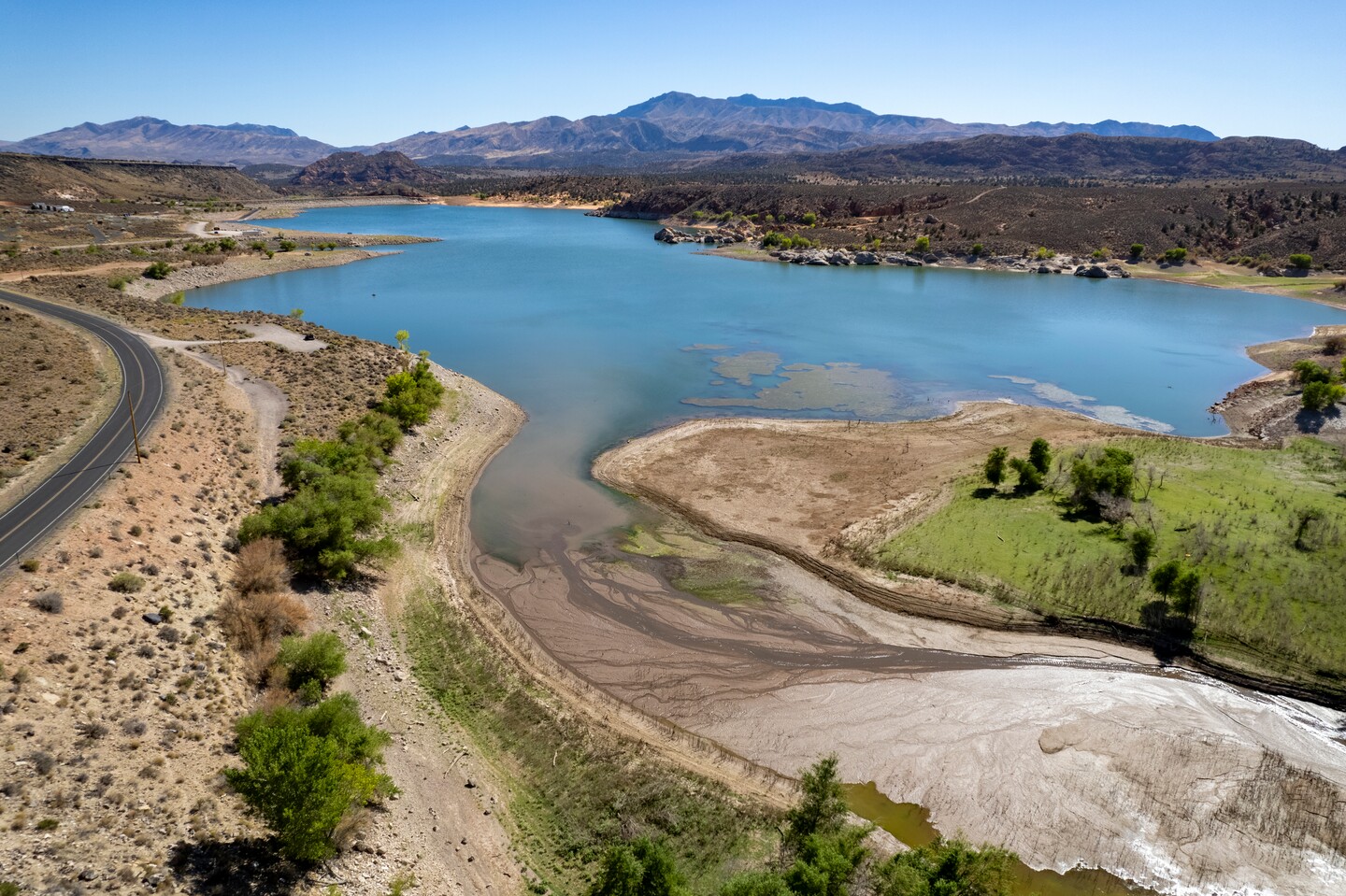
The question hangs in the desert air: Can Washington County really support the thousands of people moving here year after year?
If you're considering making Southern Utah home, it's a legitimate concern. The region has become one of the fastest-growing areas in the entire state, with families and retirees discovering its stunning red rock landscapes, outdoor recreation, and thriving real estate market. But water is life in the desert, and for a region where growth is booming, the supply question isn't one to ignore.
The good news? Absolutely. Washington County will have enough water to support growth. But it's worth understanding how and why local leaders have spent the last two decades building the infrastructure to make it happen.
CURRENT AND PROJECTED WATER NEEDS
Let's start with the reality. Washington County is Utah's hottest and driest region. The Virgin River Basin, which supplies nearly all of the county's water, is essentially at full development capacity. For decades, it was the only significant source available.
Today, the district and its municipal partners currently deliver nearly 86,000 acre-feet of water annually. That sounds substantial until you look at the growth trajectory. Washington County's population is projected to more than double by 2060, that's from roughly 200,000 today to over 400,000 in just three decades. Add in seasonal tourism that brings hundreds of thousands of visitors annually to places like Zion National Park, Snow Canyon, and Red Rock areas, and you have competing demands on a limited, drought-vulnerable supply.
The challenge is real, but it's not a surprise. Water leaders recognized years ago that the Virgin River alone couldn't sustain this kind of growth. That realization sparked a comprehensive, multi-faceted strategy that addresses water needs from every angle: conservation, recycling, new infrastructure, groundwater optimization, and the development of entirely new local water supplies. None of these approaches alone solves the problem. Together, they create a sustainable foundation for decades of growth.
THE STRATEGY: A COMPREHENSIVE, MULTI-PILLAR APPROACH
Rather than banking on a single solution or hoping technology would solve the problem later, the Washington County Water Conservancy District has pursued something far smarter: diversifying where the county's water comes from while simultaneously reducing how much water residents need to use.
The strategy rests on six interconnected pillars, each working in concert to ensure Washington County has enough water for current residents and the families moving here for decades to come.
WATER CONSERVATION
Here's something that often gets overlooked in water shortage discussions: Southern Utah has already made dramatic progress on water conservation, and that progress is accelerating.
The Washington County Water Conservancy District, in partnership with its eight municipal partners, has invested more than $70 million in recent conservation efforts. Those investments are delivering real, measurable results across multiple sectors.
Landscape and Outdoor Water Reduction
Outdoor water use is the single largest consumption category in Washington County, typically accounting for 50-60% of municipal water use. The district has tackled this aggressively through landscape ordinances that have shifted the region toward drought-resistant plants and xeriscaping practices.
Desert-adapted landscaping looks dramatically different than traditional turf-heavy landscapes. Native plants like desert marigold, four o'clock, desert willow, and various native shrubs and grasses require a fraction of the water that traditional lawns demand. The district has promoted these plants through education campaigns, rebate programs, and new development standards.
In addition to plant selection, landscape irrigation has become vastly more efficient. Smart irrigation controllers that adjust watering based on weather conditions, soil moisture sensors that prevent overwatering, and drip irrigation systems that deliver water directly to plant roots instead of spraying it into the air. These innovations have replaced older, wasteful sprinkler systems.
Some neighborhoods have seen outdoor water use drop by 30-50% through landscape conversion and irrigation modernization, while maintaining or even improving the aesthetic appeal of properties.
Ultra-Water-Efficient Home Standards
In a pioneering move, the Washington County Water Conservancy District implemented Ultra-Water-Efficient (UWE) home standards in 2025. These standards represent the most aggressive residential water efficiency requirements in the state.
Homes built to UWE standards are estimated to use 30 percent less water than homes built to current conventional standards. Here's what that means in practice:
- Water-efficient fixtures throughout: UWE homes feature low-flow toilets (0.8 gallons per flush vs. 1.6 GPF standard), low-flow showerheads, and aerating faucets that reduce water while maintaining performance
- Hot water delivery systems: instant hot water delivery or hot water recirculation systems that minimize the amount of cold water wasted while waiting for hot water
- Landscaping requirements: all UWE homes must be built with drought-resistant landscaping and efficient irrigation as standard, not optional
- Indoor water audits: the homes are designed and tested to minimize leaks and waste
- Smart water monitoring: some UWE homes include water monitoring systems that alert residents to potential leaks
For homebuyers, this is significant. Newer homes built to UWE standards simply consume less water from day one. Your household's water footprint is smaller. Your utility bills are lower. And you're part of the solution rather than part of the problem.
As more homes in the county are built to UWE standards, the overall per-capita water consumption drops, which means population growth doesn't translate into proportional demand growth. A county with 400,000 residents living in UWE homes might use less total water than a county with 250,000 residents in conventional homes.
Public Education and Behavioral Change
The district has invested heavily in public education, recognizing that conservation requires both infrastructure changes and behavioral change.
Annual conservation campaigns emphasize outdoor water reduction (such as "20% outdoor water use reduction" pledges during critical drought periods), indoor water savings, and awareness of peak demand periods. Rebate programs reward residents who upgrade to water-efficient appliances, landscape conversion programs offer free or subsidized xeriscaping installation, and landscape audits help property owners identify specific water savings opportunities.
These efforts have contributed to Washington County reducing its per-capita water use significantly over the past two decades, even as population has grown. The district has achieved this rare combination of population growth with stable or declining total water consumption. This is a testament to effective conservation programs.
EXPANDED WATER REUSE: CREATING NEW WATER THROUGH RECYCLING
The centerpiece of Washington County's long-term water strategy is the Regional Reuse Purification System, a $1 billion infrastructure project that's transforming how the county thinks about water supply.
This is where innovation meets sustainability in a very tangible, concrete way.
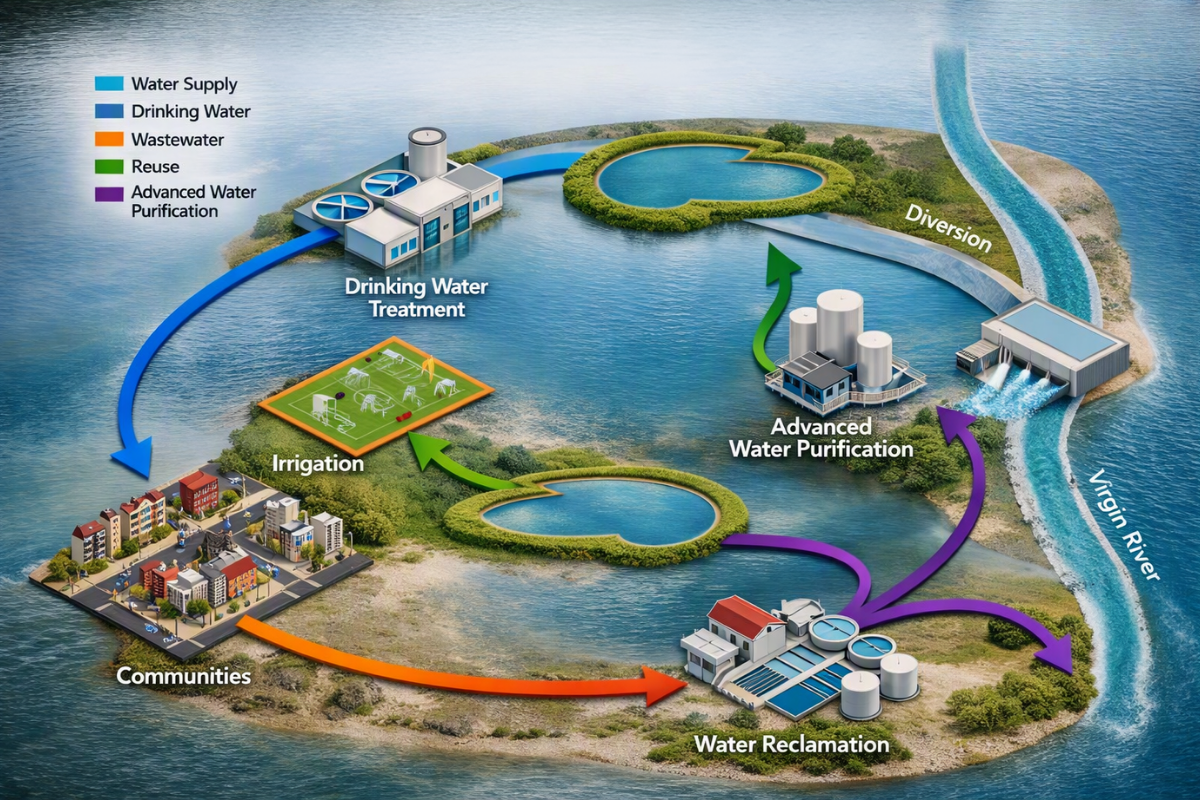
How Water Recycling Works
The basic concept is elegant: water doesn't have to be used just once. Treated wastewater can be recycled and purified to drinking-water standards, or used directly for outdoor irrigation and other non-potable purposes without requiring full potable treatment.
Here's the journey of recycled water through the system:
Collection and Treatment: Wastewater from homes, businesses, and institutions flows to treatment plants in St. George and throughout the county. The existing St. George reclamation facility is one of the most advanced in the region.
Primary Treatment: The wastewater goes through traditional treatment processes: screening, settling, and biological treatment. These remove solids and reduce organic matter.
Advanced Treatment: For non-potable reuse (outdoor irrigation, landscape watering, dust control), water goes through filtration and UV or chlorine disinfection, producing "Type 1" recycled water suitable for landscape irrigation and outdoor uses.
Potable Reuse Purification (for future phases): For water that will eventually be blended into the potable supply or used for indirect potable reuse, the district will employ advanced treatment trains including membrane filtration, reverse osmosis, ultraviolet light, and activated carbon adsorption. These processes produce water that meets or exceeds EPA drinking water standards.
Storage and Distribution: Treated recycled water is stored in ponds or reservoirs and distributed through separate pipeline networks to customers who use it for landscape irrigation, park maintenance, golf course watering, toilet flushing in public buildings, and other approved non-potable uses. In future phases, some recycled water will be stored in Sand Hollow and Quail Creek reservoirs, where it mixes with potable water supplies.
Why Water Recycling is Transformational
Water recycling isn't new. More than 70 communities worldwide are using similar systems, from California's Orange County (recycling water for 25+ years) to Singapore (where recycled water is critical to national water security) to the Middle East and Australia.
But for Southern Utah, water recycling represents a bold shift: instead of only developing new external water sources or imposing stricter conservation, the region is creating new water supply from within by recycling what's already being used. This is particularly powerful because:
Local control: Unlike water rights that depend on interstate agreements or Colorado River allocations, recycled water is locally produced from locally used water. It's not subject to drought, climate variability affecting snowpack, or political negotiations with other states.
Drought-proof: Ironically, recycled water production becomes more reliable during drought. When less water is available for outdoor irrigation due to conservation, more treated wastewater is available for recycling. The system actually becomes more drought-resistant over time.
Reduces Virgin River demand: Every acre-foot of recycled water used is an acre-foot less that must come from the Virgin River, reducing pressure on an already fully allocated water source.
Cost-effective long-term: While the upfront infrastructure costs are substantial, recycled water is cost-competitive with external water sources over time, and much less expensive than desalination or other alternative supplies.
Current and Projected Recycled Water Capacity
The system is coming online in phases, with the earliest producing benefits within just a few years.
Current operations: The existing St. George reclamation facility is currently operational and producing recycled water for landscape irrigation throughout the region.
Near-term expansion (2026-2029): The Dry Wash and Graveyard reservoirs are under construction and will add approximately 1,450 acre-feet of annual reuse capacity when completed between 2026 and 2029. The Chief Toquer Reservoir (discussed below) will also contribute to water storage and recycled water distribution.
Intermediate phase (2030): Completion of major transmission infrastructure and an advanced water treatment plant will enable a significant jump in reuse water production. By 2030, the system is projected to deliver approximately 15,888 acre-feet annually. This represents nearly a 50% increase over initial phases.
Full build-out (2042): By 2042, at full system completion, the regional reuse system will deliver more than 24,000 acre-feet of water annually. To put that in perspective: that's enough water for 40,000 homes. That's an entire new city's worth of water supply created from recycled water rather than depleted from the Virgin River.
The timeline is aggressive but achievable. Construction is already underway on multiple components. Federal funding is in place. Municipal partners are committed. This isn't a concept. It's a permitted, funded, under-construction infrastructure project that will deliver results within just a few years.
NEW WATER INFRASTRUCTURE: BUILDING THE PHYSICAL SYSTEMS
Alongside the reuse system, the district is building new storage capacity and treatment facilities that will modernize how Southern Utah manages water.
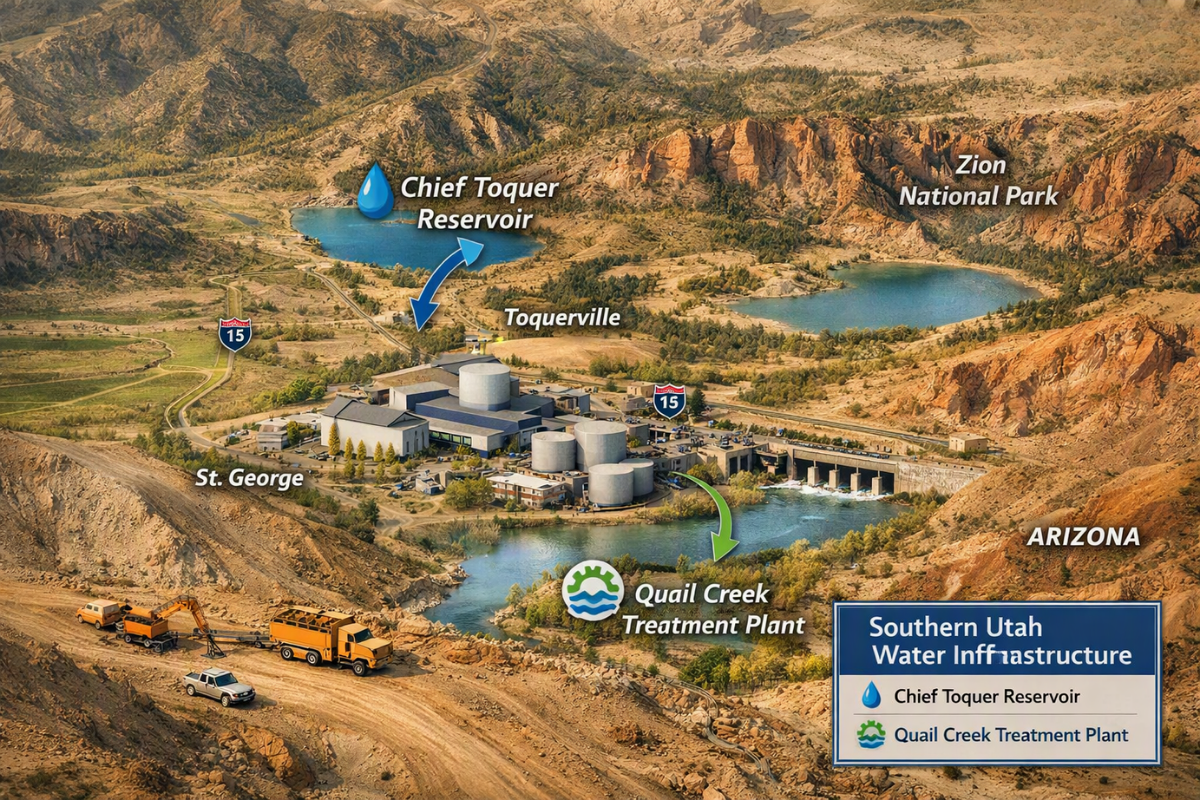
The Chief Toquer Reservoir, under construction near Toquerville, will hold 3,500 acre-feet of water and is expected to be completed in December 2026. This reservoir alone will capture water during wet periods for use during droughts, and it will serve as a storage hub for recycled water distribution. Additional reservoirs are planned as part of the broader infrastructure buildout, with new reclamation facilities and an advanced water purification facility being developed to handle the expanded reuse system.
These new reservoirs and treatment plants serve multiple purposes. They capture water during wet periods for use during dry spells. They allow treated recycled water to be stored and distributed efficiently across the county. They provide redundancy and resilience so that a problem at one facility doesn't threaten the entire system. Together with the five existing reservoirs the district currently manages with a combined capacity exceeding 100,000 acre-feet, the county has substantial storage capacity to weather even extended droughts. The Quail Creek Treatment Plant is also being expanded, with a new filter system and 4.5-million-gallon tank that will boost its treatment capacity to 25 million gallons per day.
GROUNDWATER OPTIMIZATION
While the Virgin River's surface water supply is essentially at capacity, Washington County has significant groundwater resources that, when developed responsibly, provide an important supplement to surface water supplies.
Groundwater Resources and Aquifers
Washington County's groundwater comes from several aquifer systems, including the Upper Virgin River aquifer and deeper confined aquifers. These aquifers contain substantial water resources that accumulated over thousands of years from precipitation and surface water infiltration.
Groundwater provides several advantages for water supply:
- Drought buffer: Groundwater doesn't depend on current snowpack or seasonal runoff. Even during extended surface drought, groundwater provides a reliable baseline supply.
- Storage: Aquifers act as natural storage, holding water until it's needed.
- Quality: Groundwater typically requires less treatment than surface water, having been naturally filtered through layers of soil and rock.
- Distribution: Groundwater can be accessed through individual wells positioned throughout the county, reducing dependence on long-distance pipeline infrastructure.
Responsible Groundwater Development
The district is developing groundwater resources strategically through new well systems, pump station upgrades, and extraction methods that are carefully monitored to ensure sustainability.
Unlike surface water, which is allocated through established water rights, groundwater development requires a different approach focused on ensuring that extraction doesn't exceed natural recharge rates.
Sustainable yield assessment: Hydrogeologists have determined the sustainable yield for various aquifer systems. This is essentially how much water can be pumped annually without depleting the aquifer over time. The district's groundwater development is designed to operate within these sustainable yield limits.
Monitoring networks: The district maintains monitoring wells throughout the county that track groundwater levels and quality. If levels begin declining beyond projections, extraction rates are adjusted to maintain sustainability.
Integration with surface water: Groundwater is managed as part of the overall system. During wet years when surface water is abundant, groundwater extraction is minimized. During dry years, groundwater pumping increases to supplement surface supplies. This coordinated approach maximizes overall system efficiency.
State and federal coordination: Groundwater development is done in coordination with the Utah Division of Water Resources and federal agencies to ensure compliance with state water law and any applicable interstate compacts.
Groundwater's Role in the Long-Term Strategy
By 2060, groundwater is projected to contribute approximately 15,000 to 20,000 acre-feet annually to the county's water supply. This represents a substantial addition to the Virgin River's 86,000 acre-feet, but it's developed carefully to ensure long-term sustainability. Groundwater alone won't solve the county's water needs, but as one component of the comprehensive strategy (alongside conservation, recycling, and new infrastructure), it's a critical piece.
DEVELOPMENT OF ADDITIONAL LOCAL WATER SUPPLIES
Beyond the Virgin River, groundwater, and recycled water, the district is actively developing additional local water sources that reduce dependence on any single supply and add resilience to the system.
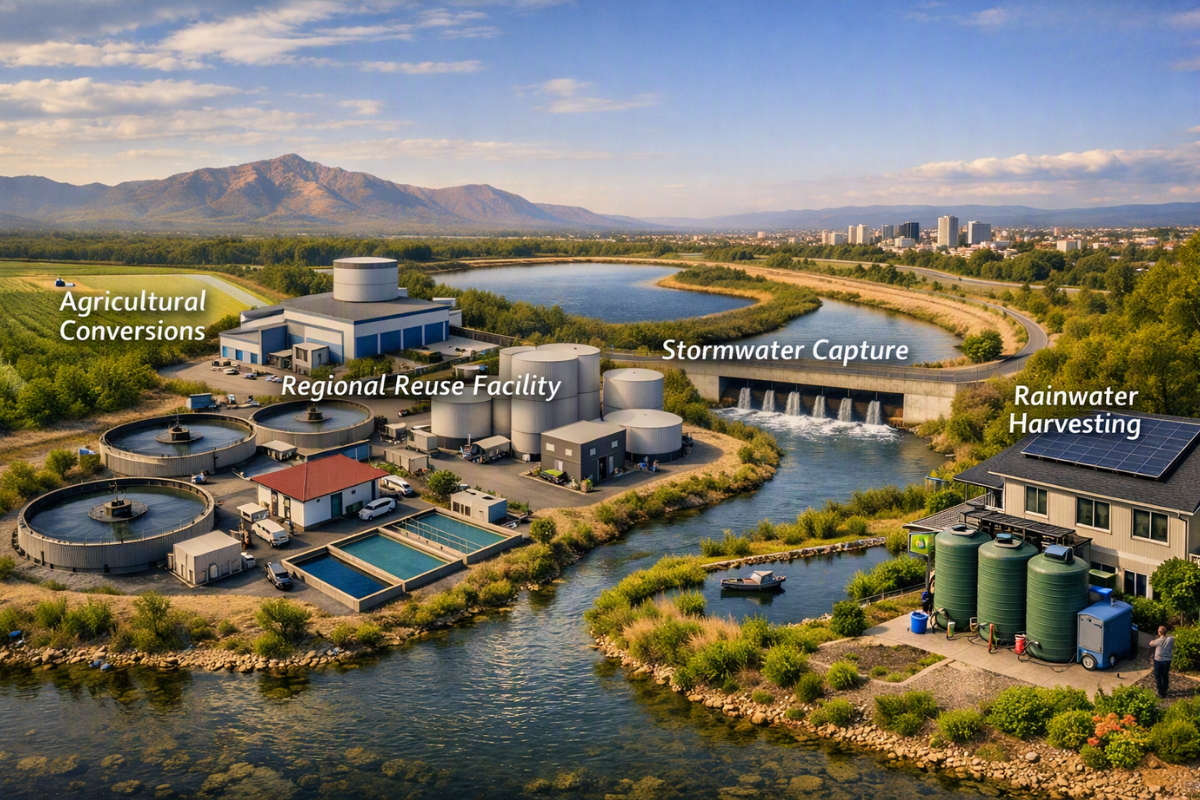
Agricultural Water Conversions
Washington County has a history of agricultural water use, with irrigation supporting farming and ranching operations. Over time, some agricultural land has been converted to urban use, but the water rights often remain tied to those operations or adjacent lands.
The district is working with agricultural water rights holders on voluntary water transfers. Essentially, they're buying or trading for agricultural water rights and converting them to municipal use. This approach:
- Compensates farmers: Agricultural water owners receive fair market value for their water rights or access to municipal water supplies for remaining operations.
- Reduces agricultural irrigation: Less water flows to lower-value agricultural uses and becomes available for higher-value municipal and residential uses.
- Preserves agricultural land where desired: The process doesn't necessarily eliminate agriculture. Instead, it allows agricultural operations to continue while freeing up water for growth.
These agricultural conversions can potentially provide an additional 5,000 to 10,000 acre-feet of water supply over time as development continues and agricultural land in the county decreases.
Local Wastewater Reuse and Recycling Programs
Beyond the centralized regional reuse system, communities are implementing local wastewater recycling programs that provide immediate water supply benefits.
Desert Color community: This is a prime example. The community developed its own wastewater reclamation system where treated wastewater is recycled and used for landscape irrigation throughout the development. This dramatically reduces the demand on potable water supplies.
Golf course and park irrigation: Throughout the county, golf courses and parks are transitioning from potable water to recycled water for irrigation. These operations use substantial quantities of water, and recycled water is ideal for these applications.
Public building applications: Municipal and county facilities are increasingly using recycled water for toilet flushing, cooling systems, and other non-potable applications, freeing up potable water for essential residential and business uses.
Stormwater Capture and Rainwater Harvesting
While Washington County's precipitation is limited, the district is increasingly capturing stormwater runoff that would otherwise be lost to evaporation or runoff. Stormwater can be treated for non-potable uses or stored for recharge to aquifers.
Rainwater harvesting systems on individual properties and public buildings capture precipitation for landscape irrigation and other uses. While individual systems contribute modest amounts, collectively these systems provide supplemental supplies that reduce overall demand on central systems.
file:///C:/Users/mace/Downloads/Regional%20Water%20Reuse%20Project%20Timeline.html
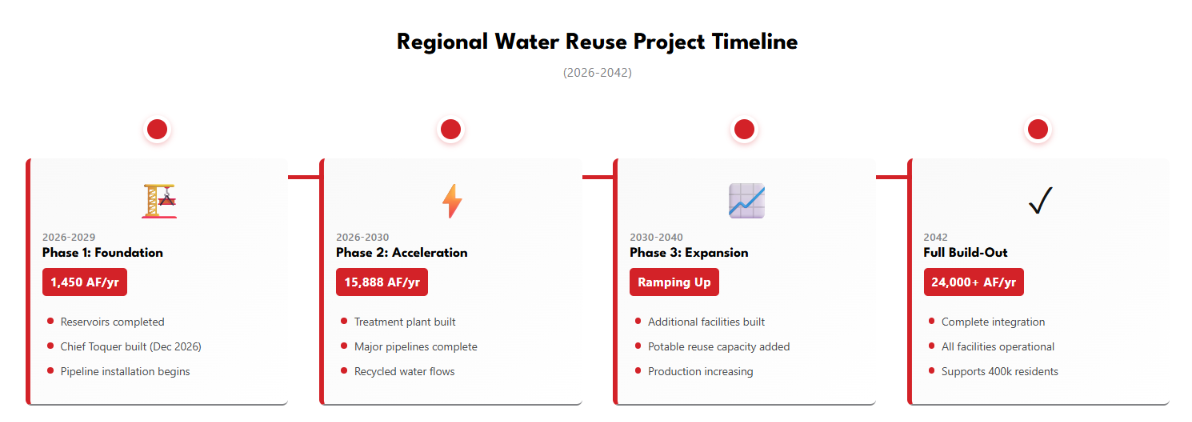
THE REGIONAL WATER REUSE PROJECT
The regional water reuse system deserves special attention because it's the single largest infrastructure investment the district is making to address growth.
By 2030, the system is projected to deliver approximately 15,888 acre-feet annually after major transmission infrastructure and treatment facilities are completed. By 2042, at full build-out, the system will deliver more than 24,000 acre-feet annually. To put that in perspective: that's enough water for 40,000 homes. That's an entire new city's worth of water supply created from recycled water rather than depleted from the Virgin River.
The federal government is backing this investment with substantial grants. The Bureau of Reclamation has awarded the district about $22 million from its large-scale water recycling grants program, and the district has allocated an additional $20.5 million in state and local funding. This isn't just a concept, it's a funded, permitted, under-construction infrastructure project that's actively being built right now.
The phased approach means the earliest benefits will arrive within just a few years. The Dry Wash and Graveyard reservoirs, due for completion between 2026 and 2029, will add 1,450 acre-feet of annual reuse capacity. Later phases will continue building capacity through 2042 and beyond.
CANSERVATION AND REUSE: THE TWO-FRONT STRATEGY
It's important to understand that conservation and recycling work together, not separately. Here's why both are essential:
Conservation alone isn't enough: Even with aggressive conservation, a population that doubles will eventually exhaust any fixed supply. Conservation is necessary but not sufficient.
Recycling alone isn't enough: Without conservation, recycled water production might never catch up with demand growth. As you recycle more water, you're also using more water (because more people are there), so the recycled water represents a share of total demand, not 100% of supply.
Together, they solve the equation: Conservation reduces per-capita demand, making the total supply problem smaller. Recycling creates new supply from existing demand. Together, these two strategies create a sustainable path forward.
COMPARISON TO OTHER WATER-SCARCE REGIONS
Washington County's strategy isn't unique. Many water-scarce regions have adopted similar approaches. What's noteworthy is the scale and speed of implementation:
- Southern California's Orange County: Has been recycling water for 25+ years, producing 70,000+ acre-feet annually. Washington County's system, once complete, will be comparable in capacity.
- Singapore: Recycles 30% of its water supply and is targeting 55% by 2060, recognizing that recycling is critical to national security.
- Australia: During the "Millennium Drought" (1997-2009), Australian cities rapidly deployed recycling systems to maintain supplies during extended drought.
- Middle East: Countries facing extreme water scarcity have invested heavily in recycling and desalination, demonstrating that these technologies work and are cost-effective when planned comprehensively.
Washington County is following a proven playbook, adapted to local conditions and implemented with local funding and partnerships.
WHY THIS MATTERS FOR HOMEBUYERS
If you're considering moving to Southern Utah, this infrastructure story matters. It's not just about water availability for the next decade. It's about whether the region can sustain growth responsibly for the next 30, 50, and 100 years.
The answer is yes. Washington County's water leaders aren't hoping for the best or betting on technology that doesn't exist. They're building the infrastructure to guarantee it.
The Virgin River may have been the county's lifeblood for generations, but it's no longer the only source keeping Southern Utah alive. Recycled water, new reservoirs, conservation programs, groundwater management, and carefully developed local supplies are the new answer.
That's something you can rely on as you build your next chapter in this remarkable corner of Utah. You're investing in a region that's planning for its future with the same seriousness that developed regions like Southern California did decades ago.
ABOUT THE AUTHOR
Eric Smith
KW Ascend, Keller Williams Realty
Red Sign Real Estate Team
(385) 360-8179
Eric Smith specializes in helping families and investors find their perfect home in Southern Utah. With deep roots in the community and expertise in the local real estate market, Eric is committed to answering your questions and guiding you through every step of your home purchase.

Red Sign Team
Real Estate Team | Red Sign Team | KW Westfield
or another way