Categories
Local Real Estate News, Utah CommunitiesPublished June 18, 2026
The New Draper Surf Park: Why Everyone Is Watching This Development

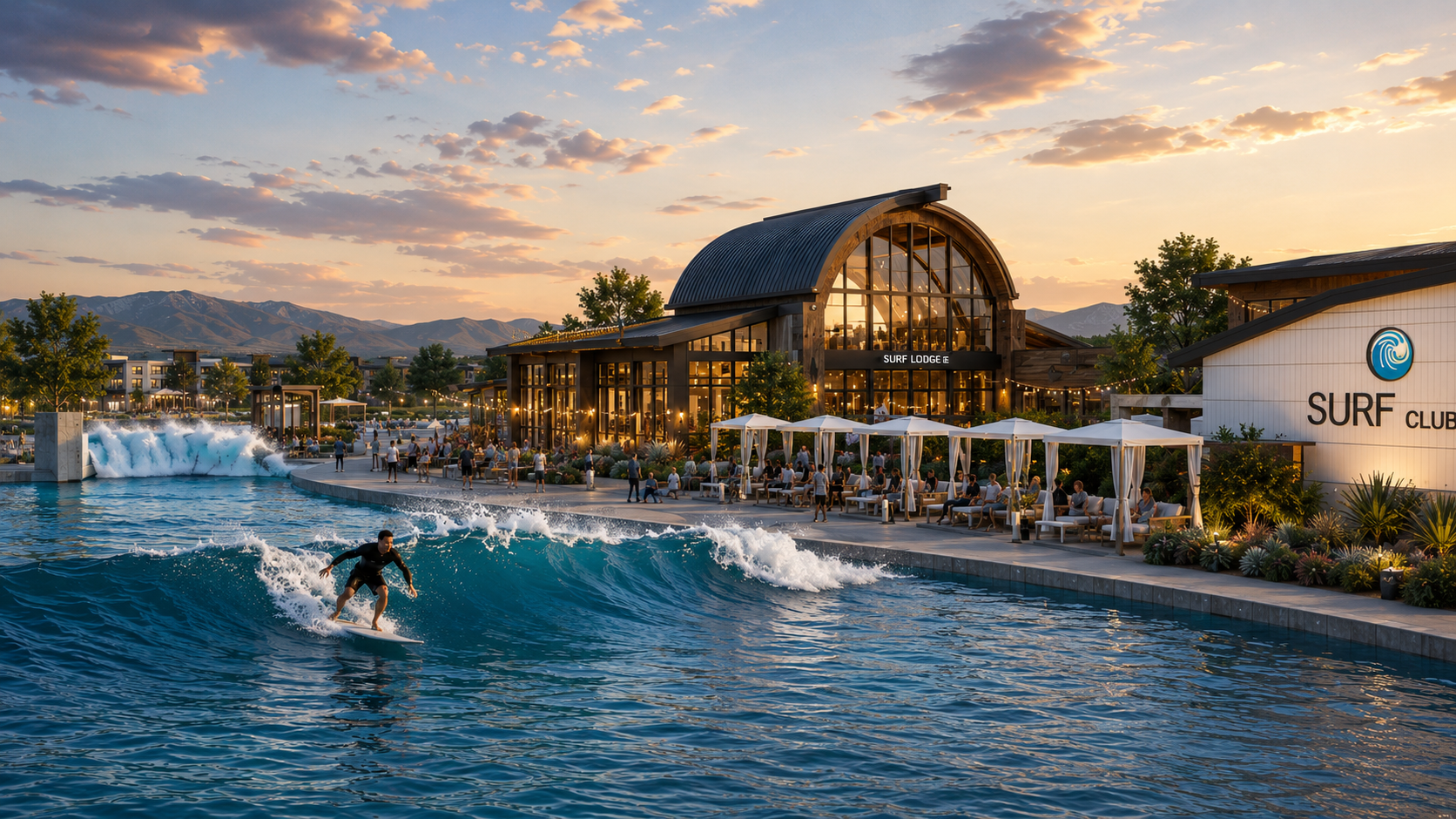
A surf park in Draper sounds almost impossible at first. Utah has ski slopes, red rock, mountain trails, and desert valleys — but ocean-style waves?
Yet one of the most interesting developments in Utah is now moving through the pipeline just west of I-15 near Bangerter Highway. The proposed Draper surf park is part of Veranda West, a larger mixed-use development that could influence recreation, traffic, housing, retail, and long-term real estate conversations around the Point of the Mountain.
WHAT IS THE NEW SURF PARK PLANNED FOR DRAPER?
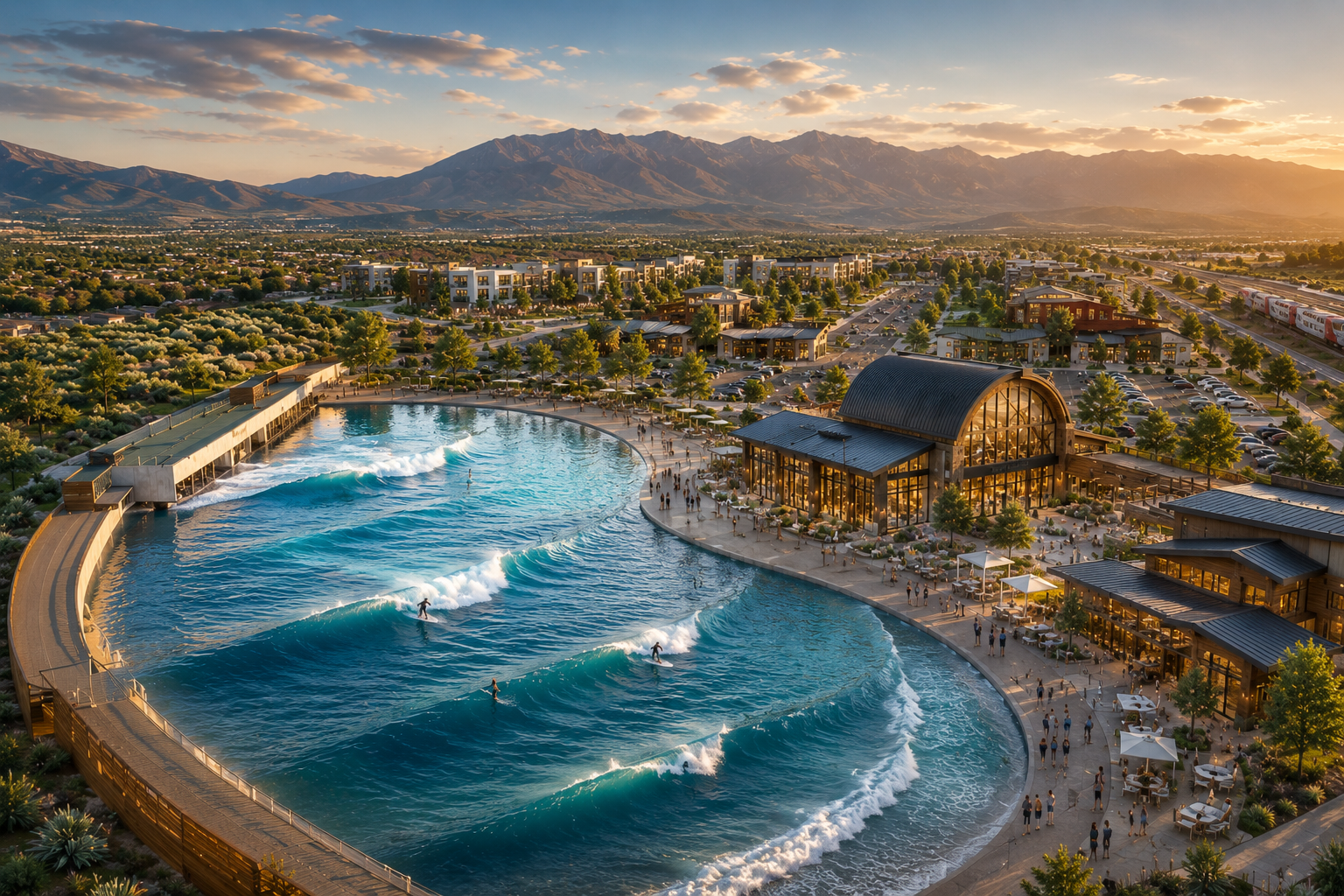
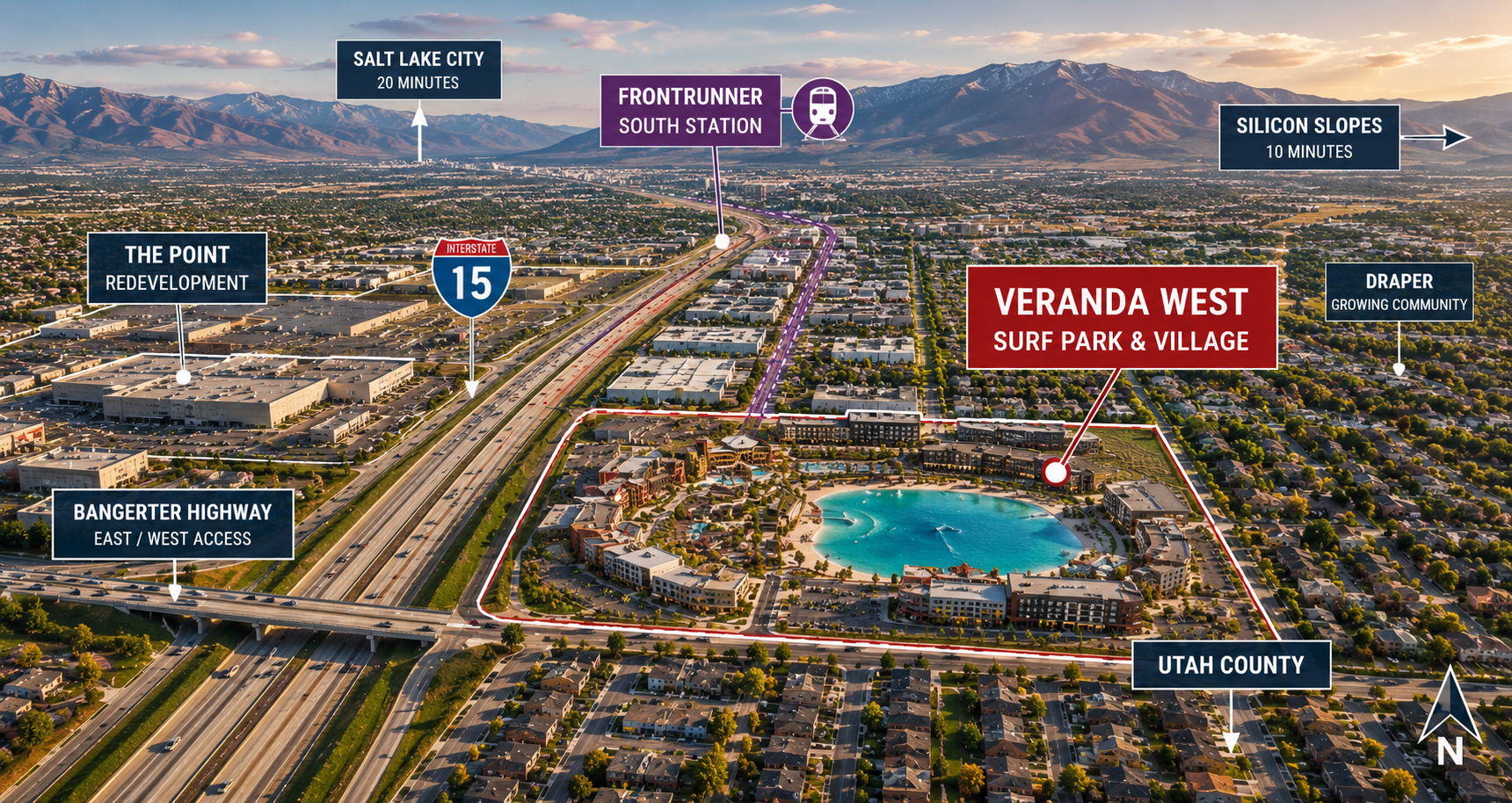
The new surf park is planned as part of Veranda West, a mixed-use development located in Draper’s transit station district zone west of I-15, off Bangerter Highway. The project is not simply a standalone pool or recreation center. It is part of a larger development pattern that brings housing, dining, shopping, and destination recreation into one connected area.
According to the approved plan reported by KSL, Veranda West includes 418 residential units, with more than 100 townhomes already built and nearly 300 apartments planned. The latest amendment expanded the apartment count and retail acreage while adding the 8.8-acre surf park as a major anchor for the development. 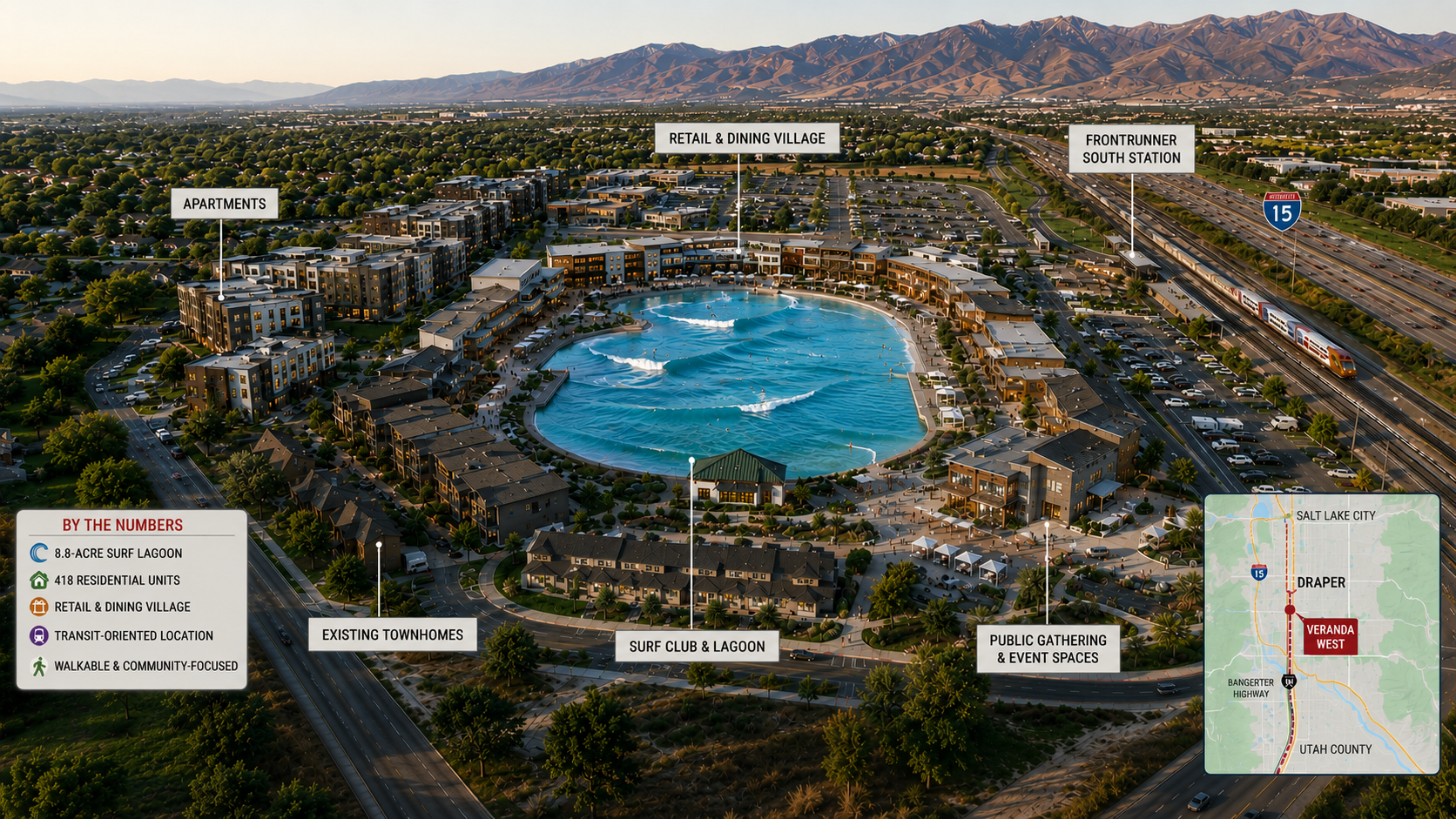
The Main Features Planned for Veranda West
The project is expected to include:
- An 8.8-acre surf park with advanced wave technology
- 418 total residential units
- More than 100 townhomes already built
- Nearly 300 apartments
- Restaurant and retail village space
- Wellness and recovery amenities
- Private cabanas and social gathering areas
- Event programming and regional recreation uses
That mix matters because this is not being framed as a novelty attraction. The surf park is intended to help create a full lifestyle district — the kind of place people visit for more than one reason. Someone might come for surf lessons, meet friends for dinner, attend an event, walk through the retail village, or simply spend time in a public-facing destination that feels different from a standard suburban shopping center.
Why It Is More Than a Wave Pool
The planned wave pool would use advanced technology to produce consistent, customizable waves for multiple skill levels. That opens the door for beginners, families, experienced surfers, and competitive athletes to use the same facility in different ways.
Project representatives have also said the surf park could serve as a national training center for men’s and women’s Olympic surf teams. That detail gives the project a different level of importance. It is one thing to build a recreational amenity. It is another to create a facility that could attract serious athletes, regional visitors, and national attention to an inland Utah city.
WHY DRAPER WAS CHOSEN
At first glance, Draper may seem like a surprising place for a surf destination. Look closer, and the choice makes more sense.
Draper sits at one of Utah’s most strategic crossroads. It connects Salt Lake County and Utah County, offers quick access to I-15 and Bangerter Highway, sits near major employment corridors, and continues to absorb growth from both directions. That geography gives the project access to a large regional population without relying only on Draper residents to support it.
The Point of the Mountain Connection
The surf park also sits near one of the most important redevelopment areas in Utah: The Point. Located on the former Utah State Prison site, The Point is planned as a major mixed-use district with housing, retail, entertainment, innovation space, office uses, education, public trails, and transit-oriented infrastructure.
The Point’s Phase 1 plan covers approximately 100 acres, which is about one-sixth of the overall site. Plans call for retail, entertainment, a people-focused main street called The Promenade, Innovation Alley, major infrastructure improvements, and the River-to-Range trail connecting the Jordan River Parkway to Draper’s Corner Canyon area.
That nearby momentum gives the Draper surf park more context. It is not happening in isolation. It is arriving in a corridor already being shaped by major public and private investment.
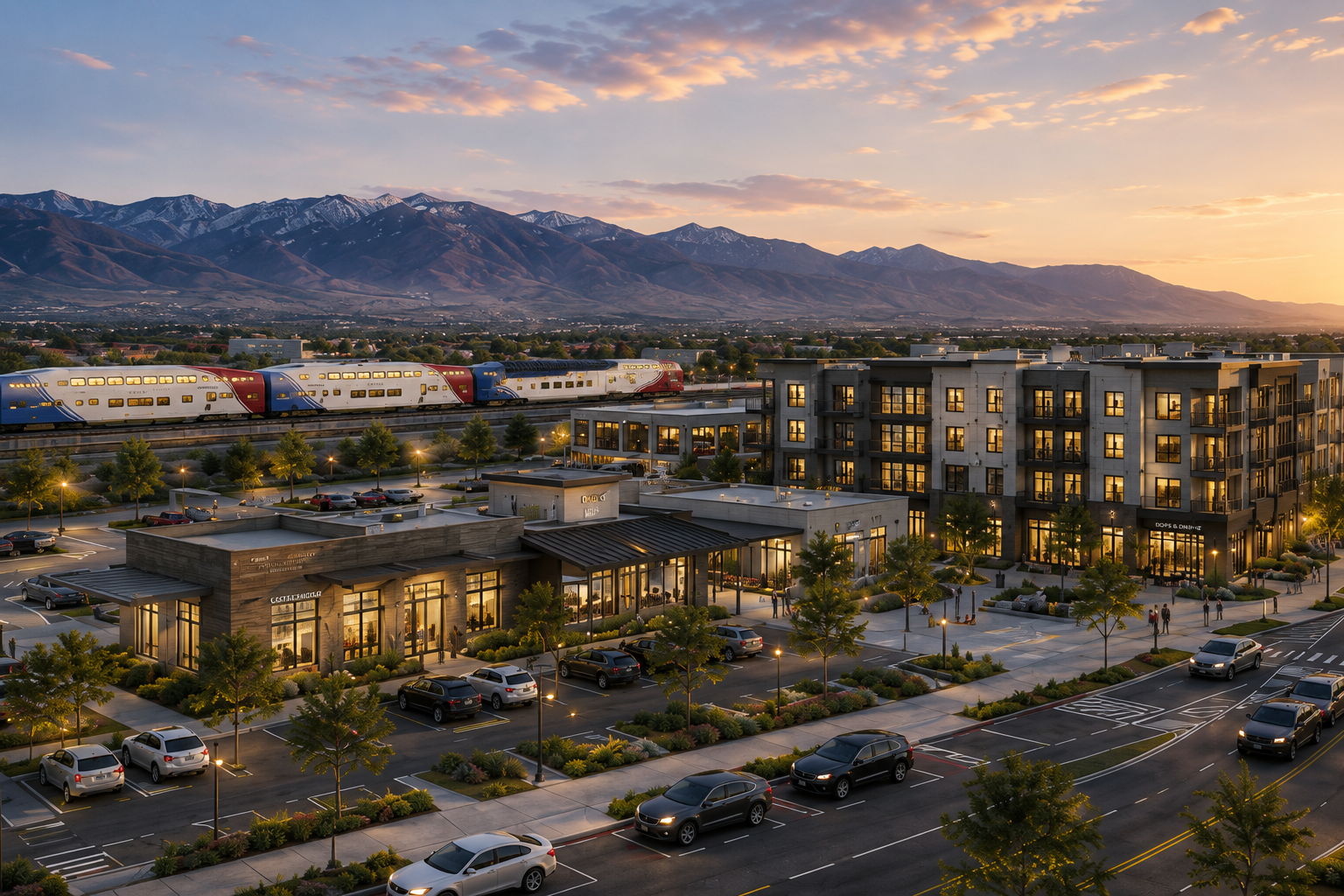
COULD DRAPER BECOME A REGIONAL DESTINATION?
The bigger story may not be surfing itself. The more important question is whether this project changes how people think about Draper.
For years, Draper has been known for hillside neighborhoods, Corner Canyon trails, tech corridor access, and a convenient location between Salt Lake City and Utah County. The surf park adds something different: destination identity. It gives people a reason to talk about Draper as more than a place to pass through on the way to Lehi, Sandy, Salt Lake City, or Utah County.
What Destination Amenities Can Change
Destination-style amenities can influence a community in several ways:
- They bring more visitors into an area.
- They support nearby restaurants and retail.
- They encourage longer visit times instead of quick errands.
- They create stronger place identity.
- They can attract additional commercial interest nearby.
- They give surrounding neighborhoods a more recognizable anchor.
None of this means Draper changes overnight. Large developments take time, and the real impact depends on execution, infrastructure, tenant mix, public access, and whether people actually use the space consistently. But when a unique amenity is paired with housing, dining, and retail, it can shift how a district functions.
That is why anyone watching this closely should pay attention not only to the surf park, but to everything around it.
WHAT IT COULD MEAN FOR NEARBY REAL ESTATE
Major amenities have a way of reshaping perception. They do not guarantee dramatic price movement, and they should never be treated as a shortcut for understanding the market. Real estate in Utah is still shaped by interest rates, inventory, job growth, affordability, school boundaries, commute patterns, and the very local differences between one neighborhood and the next.
What a project like this can do is strengthen a sense of place. People tend to respond to communities that offer daily convenience and memorable experiences close to home. Walkable districts, restaurants, entertainment, trails, transit access, and gathering spaces all influence how an area is valued over time. Veranda West combines several of those elements in one location, which is why anyone watching Draper real estate should pay attention.
The local real estate conversation will likely center on a few practical questions:
- Will nearby traffic improvements keep pace with new activity?
- How will Veranda West connect with surrounding neighborhoods and transit?
- Which retail and restaurant tenants eventually commit to the area?
- How will The Point redevelopment and Veranda West influence each other?
- Will the surf park become a consistent year-round draw or more of a seasonal attraction?
These are the questions Red Sign Team watches closely because they are the questions that turn development news into real estate context. A project can sound exciting on paper, but its market relevance depends on how it functions once people are actually living, commuting, dining, working, and gathering around it.
ADDRESSING THE WATER QUESTION
Any major water-based project in Utah will raise questions. It should.
Developers told Draper City Council that the surf park is expected to use roughly 6 million to 9 million gallons of water per year. They also said that putting high-density housing on the same footprint could use about 28 million gallons per year, while commercial development on the same acreage could use about 109 million gallons per year.
How the Closed-Loop System Is Supposed to Work
The surf park is expected to use a closed-loop system, meaning water would be recirculated rather than constantly replaced. Developers also said the system is designed to capture rainfall and snowmelt to help offset evaporation losses.
That does not end the water conversation. Utah’s long-term growth still requires careful water planning, smarter landscaping, infrastructure investment, and realistic conversations about consumption. But the details matter. The project is being presented as a recirculating system within a mixed-use development, not as an open-ended water feature.
For those navigating Utah real estate right now, this is a useful reminder: water will continue to shape development conversations across Salt Lake County, Utah County, Davis County, and beyond. Projects that address water directly will likely face more thoughtful scrutiny than projects that ignore the issue.
TRAFFIC, JOBS, AND LOCAL ECONOMIC IMPACT
Traffic may become one of the most important day-to-day issues tied to the project. Veranda West is located on the north side of Bangerter Highway near 600 West, and a traffic impact study found that improvements will be needed to support future activity.
That includes a new signal on 600 West.
Road Improvements Will Matter
Successful destination projects create movement. People arrive for lessons, events, dining, work, and weekend recreation. Residents come and go. Restaurants and retailers need deliveries. Service workers, visitors, and nearby residents all share the same road network.
That means the transportation side of this project deserves as much attention as the renderings. A great concept can feel very different depending on access, circulation, parking, pedestrian design, and road capacity.
The Economic Impact Developers Are Projecting
Developers have projected 100 to 150 local jobs and approximately $23 million in annual contribution to the local economy. Those numbers are meaningful, but the longer-term impact may come from how the project supports nearby businesses and encourages additional investment in the corridor.
The most successful version of Veranda West would not be just a place people drive to once. It would become a repeat destination woven into the daily and weekly patterns of the south Salt Lake Valley.
HOW THIS FITS INTO UTAH'S GROWTH STORY
Utah continues to wrestle with a difficult balancing act: growth, housing needs, transportation pressure, water concerns, economic opportunity, and quality of life. The Wasatch Front is not standing still, and the south end of Salt Lake Valley is one of the clearest examples of that reality.
Projects like Veranda West are important because they combine several growth trends in one place. There is housing density near transportation. There is retail and dining. There is recreation. There is a destination-style anchor. Nearby, The Point is bringing an even larger redevelopment vision into the same geographic corridor. That concentration of activity is why the Point of the Mountain keeps showing up in serious conversations about Utah’s future.
For Utah homeowners and those looking to become one, this is the kind of development that helps explain where momentum may be building. It is not about chasing headlines. It is about understanding how infrastructure, amenities, employment centers, and regional identity gradually shape demand.
Red Sign Team looks at projects like this through that lens. Not as hype. As context.
WHAT HAPPENS NEXT?
Draper City Council approved Ordinance #1719 on June 9, 2026, amending the Veranda West Master Area Plan. The council also approved related Ordinance #1720, tied to the Veranda West Master Area Plan transit station district sub-zone designation map. Both were approved 5-0, according to the city meeting recap.
The Simple Timeline
- 2019: Initial master plan adopted for Veranda West
- 2020: Earlier amendment made to the plan
- May 28, 2026: Public hearing notice posted for the Veranda West amendment
- June 9, 2026: Draper City Council approved Ordinances #1719 and #1720
- Fall 2026: Surf park construction anticipated to begin
- 2028: Target opening date for the surf park
A lot can change between approval and opening day. Construction schedules shift. Financing conditions change. Tenant lineups evolve. Infrastructure work can move faster or slower than expected. But the key point is clear: the Draper surf park has moved beyond the “interesting idea” stage and into the formal development pipeline.
THE BOTTOM LINE
The new surf park in Draper is about much more than making waves in the middle of Utah. It is part of a larger shift happening near the Point of the Mountain, where housing, recreation, transportation, retail, employment, and public infrastructure are beginning to overlap in a more intentional way.
That does not mean every nearby property suddenly changes in value. It does mean Draper is becoming part of a bigger regional story, and the communities surrounding this corridor deserve closer attention. The best real estate decisions in Utah rarely come from a single headline. They come from understanding how projects like this fit into the larger pattern.
Red Sign Team helps people make sense of those patterns across Utah’s fast-changing communities. To explore how local development, neighborhood trends, and market timing may affect your next move, connect with Red Sign Team’s Utah real estate services and start with a local conversation grounded in what is actually happening.
Red Sign Team
Real Estate Team | Red Sign Team | KW Westfield
or another way