Categories
Local Market Updates, Utah Real Estate NewsPublished August 4, 2026
Eagle Mountain Property Tax Increase 2026 Explained
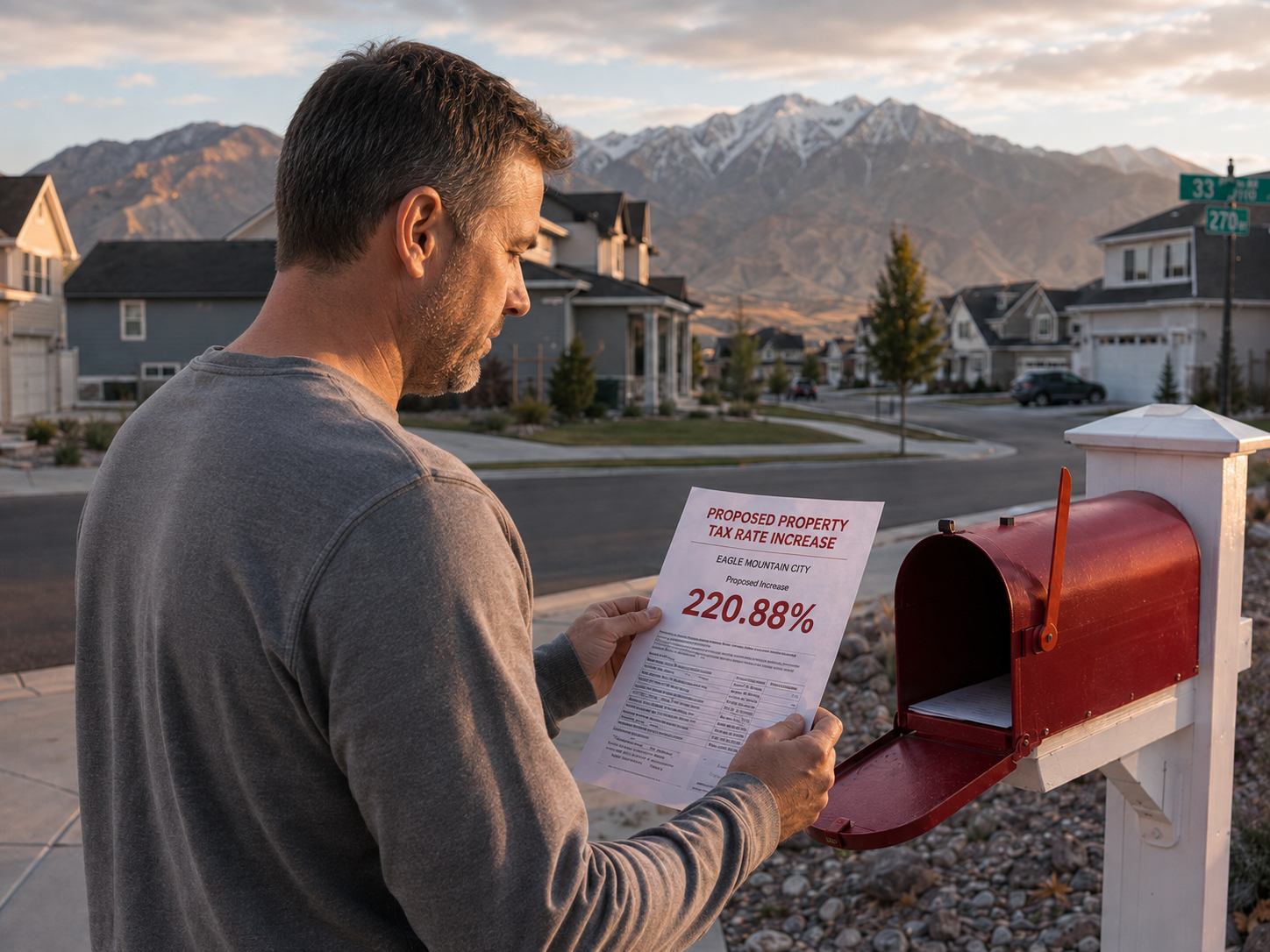
If you own a home in Eagle Mountain, the proposed 220.88% Eagle Mountain property tax increase probably caught your attention. The number sounds severe, but it does not mean your entire property tax bill is about to triple. For the city’s example $488,000 primary residence, the Eagle Mountain City portion would increase by about $314 per year, or roughly $26 per month.
That difference matters, especially when you are already balancing a mortgage, insurance, HOA dues, and other household costs. This guide explains what the 220.88% figure actually measures, why Eagle Mountain is proposing the increase, where the additional revenue would go, and what the change could mean if you are buying, owning, or selling a home in Eagle Mountain or elsewhere in Utah County.
Status note: This article reflects information available as of August 4, 2026. The proposal is not final.
EAGLE MOUNTAIN PROPERTY TAX INCREASE: QUICK ANSWER
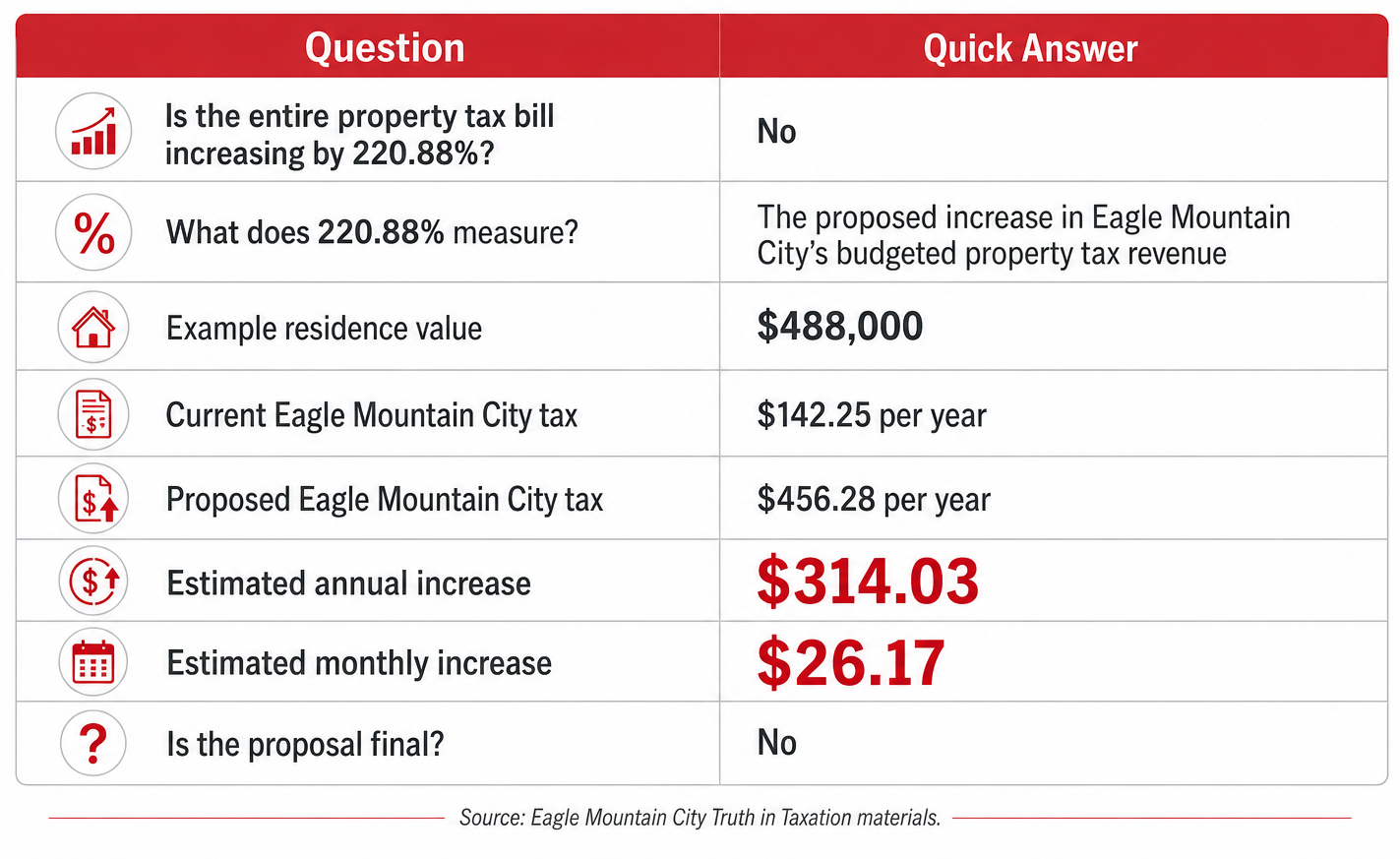
The official Notice of Proposed Tax Increase states that Eagle Mountain City would receive an additional $6,742,938 in annual property tax revenue if the proposed budget is approved.
WHAT THE 220.88% PROPERTY TAX FIGURE REALLY MEANS
It does not apply to your entire property tax bill
Your Utah County property tax bill contains charges from several separate taxing entities.
For a typical Eagle Mountain residence in Tax Area 038, those entities include:
- Alpine School District
- Eagle Mountain City
- Unified Fire Authority
- Utah County
- Central Utah Water Conservancy District
- Assessing and collecting services
Under the proposed rates, Eagle Mountain City estimates that its portion would represent approximately 15.92% of the total bill for a $488,000 primary residence. The estimated total annual tax would be about $2,866, with approximately $456 going to Eagle Mountain City.
That means these statements can both be true:
- Eagle Mountain City’s budgeted property tax revenue would increase by 220.88%.
- The homeowner’s total property tax bill would not increase by 220.88%.
The official notice uses 220.88% because that is how much the city proposes to increase its budgeted property tax revenue above the previous year, excluding eligible new growth.
The numbers side by side
Forget the headline percentage for a moment. Here is what changes in the city portion of the bill for the official example home.
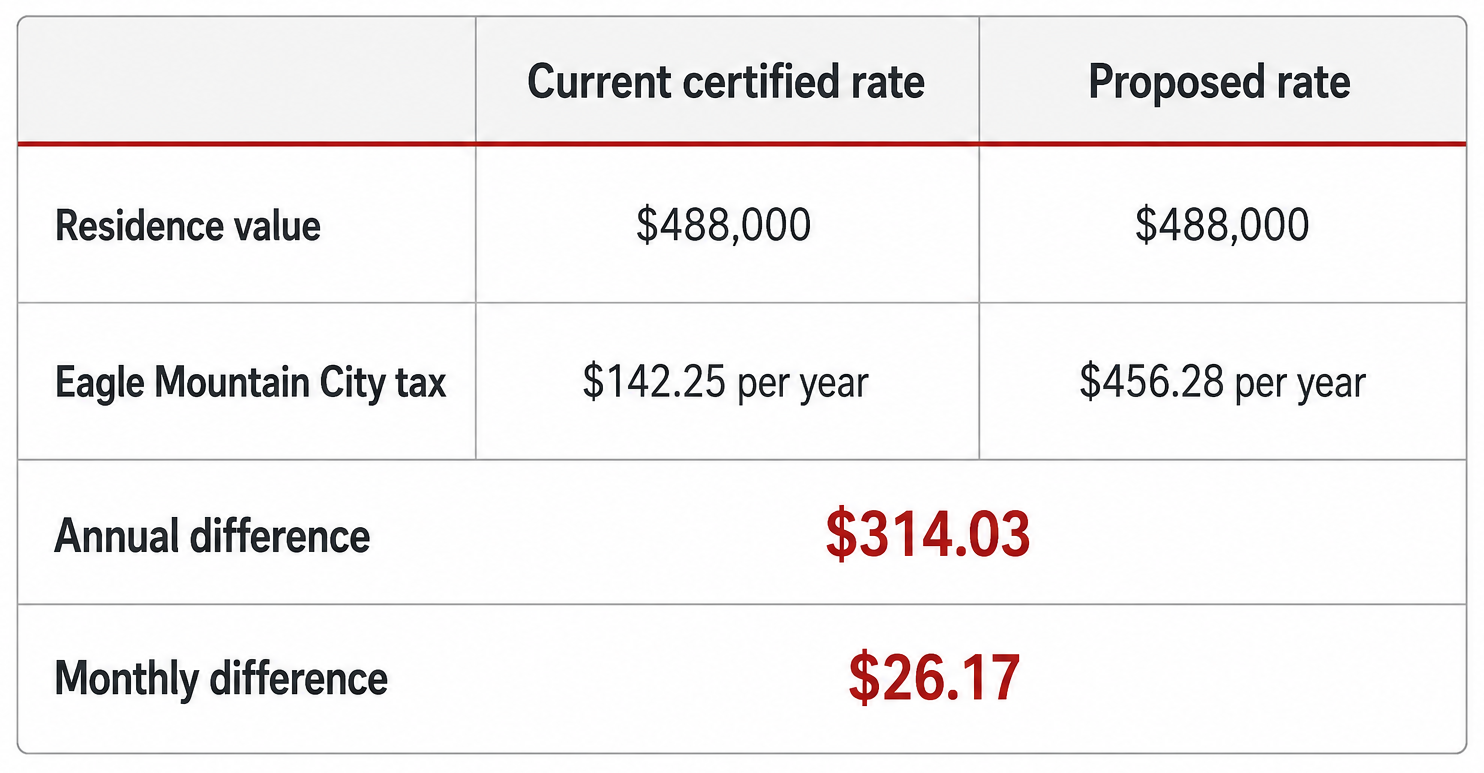
The current calculation uses Eagle Mountain’s certified rate of 0.000530. The proposed calculation uses a rate of 0.001700.
Bottom line: The 220.88% figure describes how large the proposed change is compared with the city’s current property tax revenue. The $314 annual amount describes the estimated effect on the city portion of an average homeowner’s bill.
Why the percentage looks so large
The increase begins from a very low city tax amount.
Eagle Mountain has not adopted a Truth in Taxation increase since 2010. The city reports that its levy declined from 0.001636 in 2011 to 0.000534 in 2025 as population and taxable development increased.
During the same period, Eagle Mountain experienced rapid population growth. The city reports that its population reached 76,695 in January 2026, approximately 3.6 times its 2010 population.
A large percentage increase from a small starting amount can still produce a much smaller household dollar increase.
Bottom line: The percentage explains the change from Eagle Mountain City’s low starting point. The dollar amount explains what the proposal could mean for your household budget.
HOW MUCH COULD THE EAGLE MOUNTAIN PROPERTY TAX INCREASE COST YOU?
Qualifying primary residences in Utah receive a 45% residential exemption. This means property taxes are generally calculated using 55% of the home’s fair market value.
The estimated Eagle Mountain City tax can be calculated as:
Market value × 55% × city tax rate
Using the current rate of 0.000530 and the proposed rate of 0.001700, the estimated city portion would be:
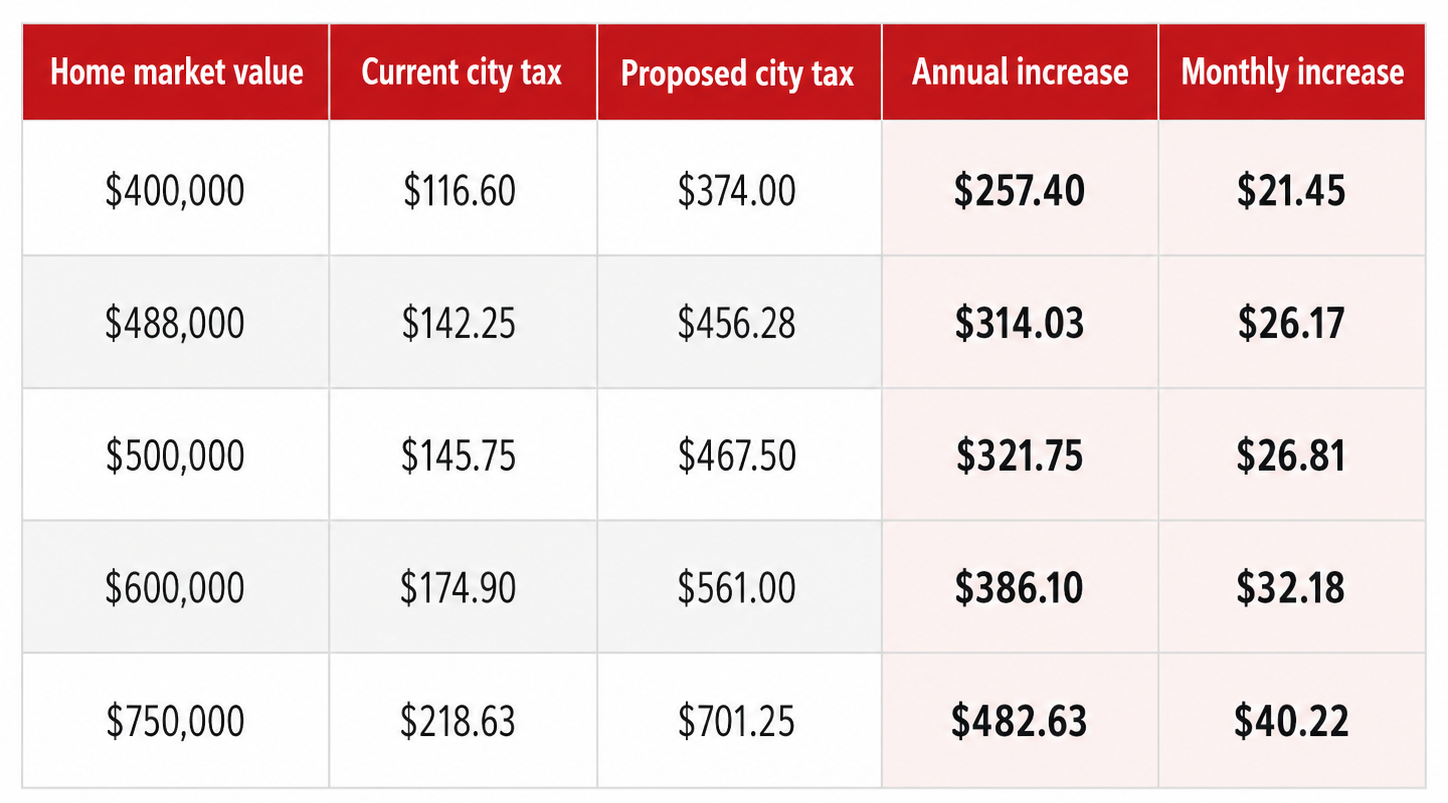
These figures estimate the Eagle Mountain City portion only. They do not estimate your complete property tax bill.
Your actual tax amount may differ based on:
- Your county assessed market value
- Your property classification
- Whether the residential exemption applies
- Your specific tax area
- Changes proposed by other taxing entities
Your Utah County Notice of Valuation and Tax Change is the best starting point for reviewing your property’s assessed value, classification, taxing entities, and proposed tax amounts.
WHY EAGLE MOUNTAIN IS PROPOSING THE PROPERTY TAX INCREASE
The proposal is focused on public safety
Eagle Mountain does not operate a separate municipal police department. The city contracts with the Utah County Sheriff’s Office for law enforcement services.
The current contract costs $8,290,200 per year. The proposed budget would add one sergeant and six deputies at a combined annual cost of $1,507,939. This would bring the total Sheriff’s Office contract to $9,798,139.
The city says the proposed property tax revenue would also total $9,798,139. According to the city, this would allow property tax revenue to fund the Sheriff’s Office contract dollar for dollar.
This remains a proposal until the City Council completes the public hearing and final budget process.
The increase would do more than add seven positions
A common question is:
If the seven additional positions cost about $1.51 million, why is the city requesting almost $6.75 million in additional property tax revenue?
Currently, Eagle Mountain’s property tax revenue does not cover the full cost of the existing Sheriff’s Office contract. The city uses revenue from other sources to pay the difference.
Based on the city’s published figures:
- About $1.51 million would fund the proposed sergeant and six deputies.
- About $5.23 million would replace other city revenue currently helping fund the existing Sheriff’s Office contract.
In simple terms, the proposal would do two things. It would add seven law enforcement positions, and it would make property tax revenue the full funding source for Eagle Mountain’s contracted law enforcement service.
This breakdown is calculated from the city’s published contract and revenue figures. Final spending would depend on the budget adopted by the City Council.
Why growth has not automatically covered the full cost
New development can expand a city’s property tax base, but growth also increases demand for law enforcement, roads, utilities, emergency response, and other public services.
Utah’s certified tax rate is calculated to provide a taxing entity with approximately the same revenue from existing property as the previous year, excluding eligible new growth. When existing property values rise across the tax base, the certified rate generally adjusts rather than allowing the taxing entity to collect the same percentage increase automatically.
An individual property owner’s bill can still change if that property’s assessed value changes differently from other properties or if another taxing entity changes its rate.
The central question for Eagle Mountain residents is whether the proposed property tax rate is the right way to fund the level of law enforcement service the growing city expects.
WHAT IS UTAH’S TRUTH IN TAXATION PROCESS?
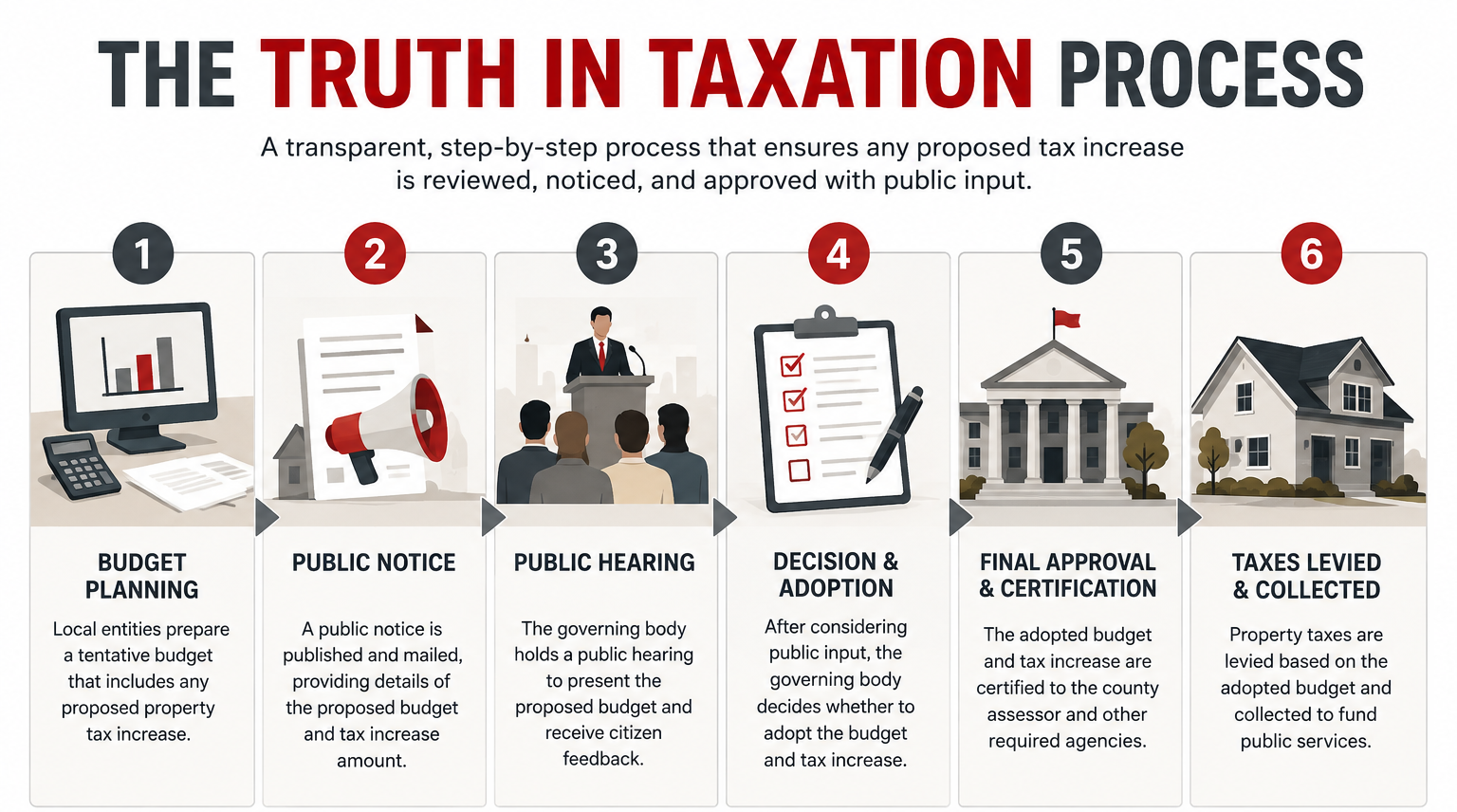
Truth in Taxation is a public disclosure process
Truth in Taxation is the process Utah taxing entities must complete before adopting a property tax rate above the calculated certified rate.
The process requires public notice, parcel specific information, advertising, and a public hearing before the higher rate can be adopted.
The process gives residents an opportunity to understand:
- How much additional revenue is being requested
- How the increase could affect residential and commercial properties
- Why the taxing entity says it needs the money
- When and where residents can provide comments
- When elected officials will vote
Receiving a notice does not mean the proposal has already been approved.
Key Eagle Mountain dates
Truth in Taxation public hearing
Thursday, August 6, 2026
6 p.m.
Final budget hearing and expected adoption
Tuesday, August 18, 2026
7 p.m.
Location
Eagle Mountain City Hall Council Chambers
1650 East Stagecoach Run
Eagle Mountain, Utah 84005
Residents may attend the August 6 hearing in person, participate virtually, or submit comments through the city’s public comment process.
The fiscal year 2026 to 2027 interim budget restricts the additional proposed property tax revenue until the Truth in Taxation process is completed and the City Council takes final action.
HOW THE EAGLE MOUNTAIN PROPERTY TAX INCREASE COULD AFFECT HOMEOWNERS
1. Your escrow payment could change
Many mortgage servicers collect money for property taxes through an escrow account. A portion of each mortgage payment is set aside, and the servicer uses that money to pay the tax bill.
If property taxes increase, the escrow portion of your monthly mortgage payment may also increase after your servicer performs an escrow analysis.
For the city’s $488,000 example, the proposed Eagle Mountain City increase equals approximately $26.17 per month.
Your actual payment change may be different because an escrow analysis can also reflect:
- Homeowners insurance changes
- An existing escrow shortage or surplus
- Rate changes from other taxing entities
- Changes to your assessed property value
The increase may not appear immediately after the City Council vote. Your mortgage servicer must first receive and process the updated tax information.
2.Your notice may show more than one proposed increase
The city’s illustration for Tax Area 038 identifies proposed changes from both Eagle Mountain City and the Central Utah Water Conservancy District.
This means the total difference shown on your valuation notice may not come entirely from the Eagle Mountain property tax proposal.
Review the amount listed beside each taxing entity rather than looking only at the total change.
3. You can appeal the property value, not the City Council’s tax policy
You may file a valuation appeal if you believe Utah County assessed your property above its fair market value.
Utah County provides a regular appeal process for filings made on or before September 15. Supporting information may include comparable sales, an appraisal, photographs, or records showing an error in the property details.
A valuation appeal challenges the county’s determination of your property’s value or classification. It does not challenge Eagle Mountain City’s decision to propose a higher tax rate.
Comments about the proposed rate should be made through the Truth in Taxation process.
WHAT THIS MEANS IF YOU ARE BUYING OR SELLING
If you are buying in Eagle Mountain
Include the proposed property tax amount when asking your lender to estimate your monthly payment.
Do not rely only on the seller’s current mortgage payment or previous escrow amount. The seller may have a different interest rate, insurance premium, assessed value, property classification, or escrow history.
For local market context, Eagle Mountain’s median sale price was approximately $507,233 during the three months ending May 2026, up 4.6% from the same period one year earlier. Homes averaged 55 days on the market, compared with 35 days the previous year.
Those numbers do not show that the tax proposal is affecting home values. They do show that buyers are taking more time to compare properties and evaluate the complete ownership cost.
Your affordability calculation should include:
- Principal and interest
- Property taxes
- Homeowners insurance
- Mortgage insurance, when applicable
- HOA dues
- Utilities
- Maintenance and repairs
The proposed tax increase should be part of your calculation, but it should be considered alongside the home’s price, loan terms, condition, location, and long term fit.
If you are selling in Eagle Mountain
Expect buyers to ask about the 220.88% headline.
A clear explanation can prevent unnecessary concern. The percentage applies to Eagle Mountain City’s budgeted property tax revenue, not the homeowner’s entire property tax bill. For the city’s example residence, the estimated increase is about $314 per year.
Provide buyers with your current property tax bill and Utah County valuation notice when appropriate. Avoid promising that a buyer’s future payment will be the same as yours.
Their total cost may differ because of financing, insurance, assessed value, exemptions, and escrow calculations.
Red Sign Real Estate Team is based in Orem and serves Eagle Mountain and communities throughout Utah County. With more than 20 agents and over 3,000 Utah homes sold, our team helps clients evaluate both the home price and the complete cost of ownership.
THE BOTTOM LINE
The proposed Eagle Mountain property tax increase is significant, but it would not triple the homeowner’s entire property tax bill.
For the city’s example $488,000 primary residence, the Eagle Mountain City portion would increase by approximately $314 per year, or $26 per month. At the proposed rate, the city estimates that its share would represent about 15.9% of the illustrated total property tax bill.
The proposal would also change how Eagle Mountain funds law enforcement.
The city says property tax revenue would cover its full Utah County Sheriff’s Office contract, including one proposed sergeant and six additional deputies. Based on the city’s published figures, most of the additional revenue would replace other city funds currently being used to pay the existing contract.
You may believe the additional public safety funding is justified. You may prefer a smaller increase, a phased approach, or a different combination of revenue sources.
Either way, the decision should be based on the full numbers rather than the 220.88% headline alone.
Review your own Utah County valuation notice, confirm your property classification, calculate the city portion using your assessed value, and participate in the public process before the proposal becomes final.
FREQUENTLY ASKED QUESTIONS
Is Eagle Mountain really proposing a 220.88% property tax increase?
Yes, but the percentage applies to Eagle Mountain City’s proposed increase in budgeted property tax revenue. It does not mean the homeowner’s entire property tax bill would increase by 220.88%.
How much would the Eagle Mountain property tax increase cost the average homeowner?
For the city’s example $488,000 primary residence, the Eagle Mountain City portion would increase by $314.03 per year. That is approximately $26.17 per month. Your amount will depend on your assessed value, property classification, and tax area.
Why does Eagle Mountain need $6.74 million if seven new positions cost $1.51 million?
The seven proposed positions would cost approximately $1.51 million. Based on the city’s figures, about $5.23 million of the additional revenue would replace other city funds currently used to pay part of the existing Sheriff’s Office contract.
Will my whole Eagle Mountain property tax bill triple?
No. Your bill includes taxes from the school district, city, county, fire authority, water district, and assessing services. In Eagle Mountain City’s Tax Area 038 example, the city would receive approximately 15.9% of the proposed total bill.
Will the Eagle Mountain property tax increase raise my mortgage payment?
It could increase the escrow portion of your payment if your mortgage servicer collects property taxes monthly. The change would generally appear after updated tax information is processed and the servicer completes an escrow analysis.
Can I appeal the Eagle Mountain property tax increase?
You can appeal Utah County’s assessed value or classification if you believe it is incorrect. A valuation appeal does not challenge the city’s proposed tax rate. Comments about the rate should be submitted through the Truth in Taxation process.
Ready to Talk Through Your Eagle Mountain Move?
Whether you're watching this proposal as a current homeowner or weighing whether now is the right time to buy in Utah County, our team can walk you through the real numbers. Search current Eagle Mountain listings or talk to a local Red Sign agent who can help you see past the headline and plan your next move with confidence.
Red Sign Team
Real Estate Team | Red Sign Team | KW Westfield
or another way