Categories
Utah Market NewsPublished October 30, 2026
Utah Housing Market Update: What Buyers and Sellers Need to Know

The Utah housing market is slower, and it is not an easy market for anyone. Based on September 2026 data from the Keller Williams Utah Q3 2026 Market Update, more homes are sitting, more sellers are cutting prices and fewer homes are going under contract, while prices and payments remain high.
That gives buyers room to negotiate and puts real pressure on sellers to price correctly. Here's what matters for each side, without the sugar-coating.
Last updated Oct. 30, 2026.
WHERE THE UTAH HOUSING MARKET STANDS
Source: Keller Williams Utah Market Update, Q3 2026
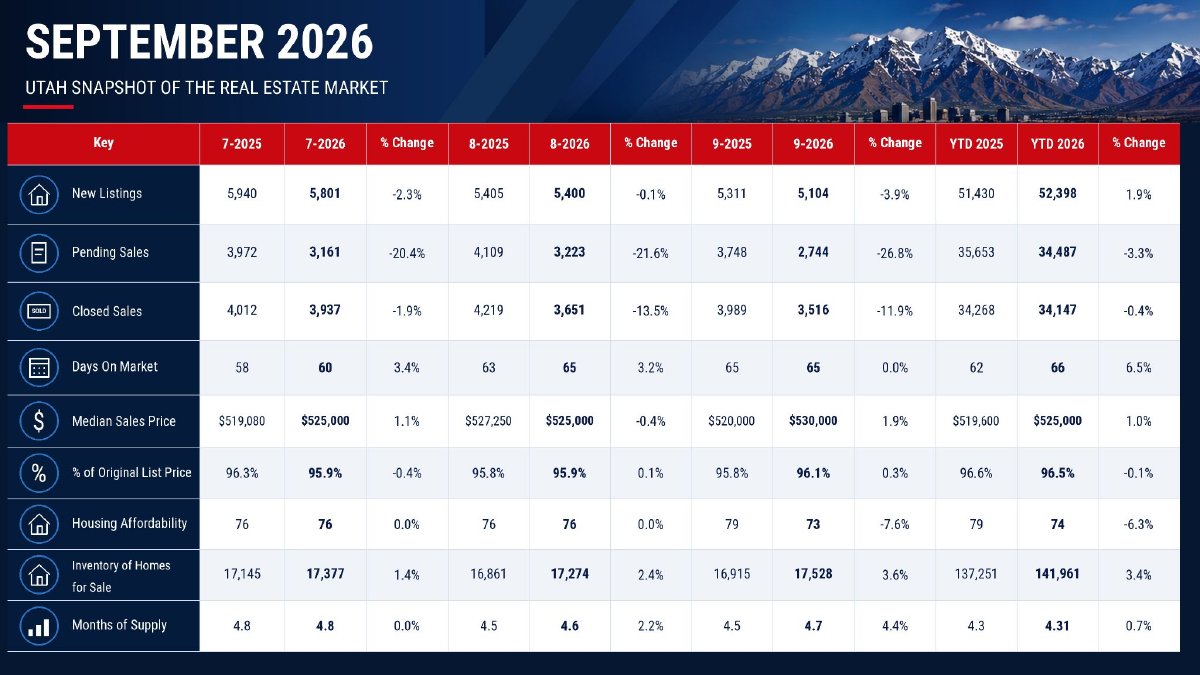
Here are the September 2026 statewide numbers that matter most, compared with September 2025:
| Measure | Sept. 2026 | Change |
|---|---|---|
| Homes for sale | 17,528 | Up 3.6% |
| New listings | 5,104 | Down 3.9% |
| Pending sales | 2,744 | Down 26.8% |
| Closed sales | 3,516 | Down 11.9% |
| Median sale price | $530,000 | Up 1.9% |
| Days on market | 65 | Flat |
| Sale price vs. original list | 96.1% | 95.8% a year earlier |
| Months of supply | 4.7 | 4.5 a year earlier |
The biggest number on that list is pending sales, down more than a quarter from a year ago. Fewer buyers are signing contracts, so homes are piling up instead of moving. Prices haven't dropped statewide, but they've barely moved, and the typical home sells below its original asking price. These are statewide numbers, so conditions in your county or city can differ; that's the backdrop.
PROS AND CONS FOR BUYERS
Source: Keller Williams Utah Market Update, Q3 2026
The pros
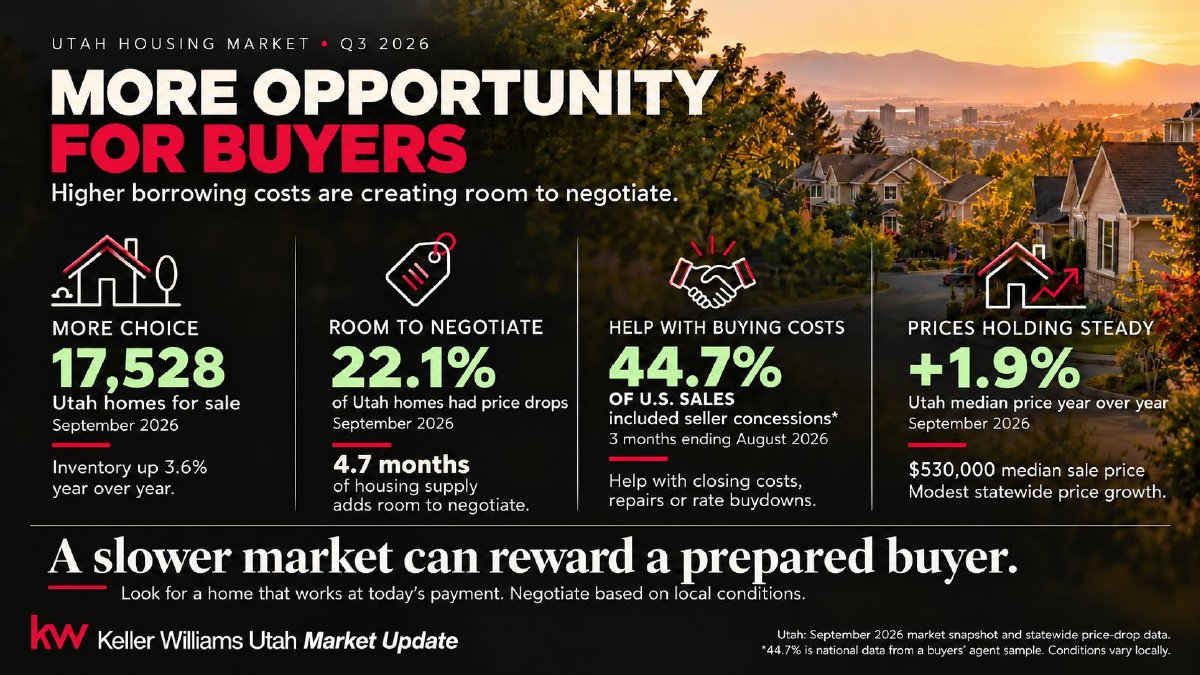
- More choice. 17,528 homes were for sale statewide in September, up 3.6% from a year ago, with 4.7 months of supply.
- Real room to negotiate. 22.1% of Utah homes had price drops in September, and homes sold for 96.1% of original list price on average.
- Sellers are offering help. Nationally, 44.7% of sales included seller concessions in the three months ending August 2026. That figure comes from a national buyers' agent sample, so conditions in Utah vary, but it shows what's on the table: closing costs, repairs and rate buydowns.
- Less competition. With pending sales down 26.8%, you're less likely to be racing several other offers on the same house.
The cons
- The payment is the problem. The 30-year fixed rate ended September at 6.86%, according to Freddie Mac, on a $530,000 median price.
- Affordability is worse, not better. Utah's Housing Affordability Index was 73 in September 2026, down from 79 a year earlier. At 100, median family income is exactly enough to buy the median-priced home.
- Prices aren't falling statewide. The median is still up 1.9% year over year. Deals happen home by home, not across the board.
What the payment looks like
Here's an illustration, not a quote: a $530,000 home with 20% down ($106,000) leaves a $424,000 loan. At 6.86% on a 30-year fixed, principal and interest come to about $2,781 a month. That leaves out property taxes, homeowners insurance, HOA dues and any mortgage insurance, and your actual rate depends on your loan and lender. On the same terms, every $10,000 you negotiate off the price trims about $52 a month from principal and interest.
Source: Keller Williams Utah Market Update, Q3 2026
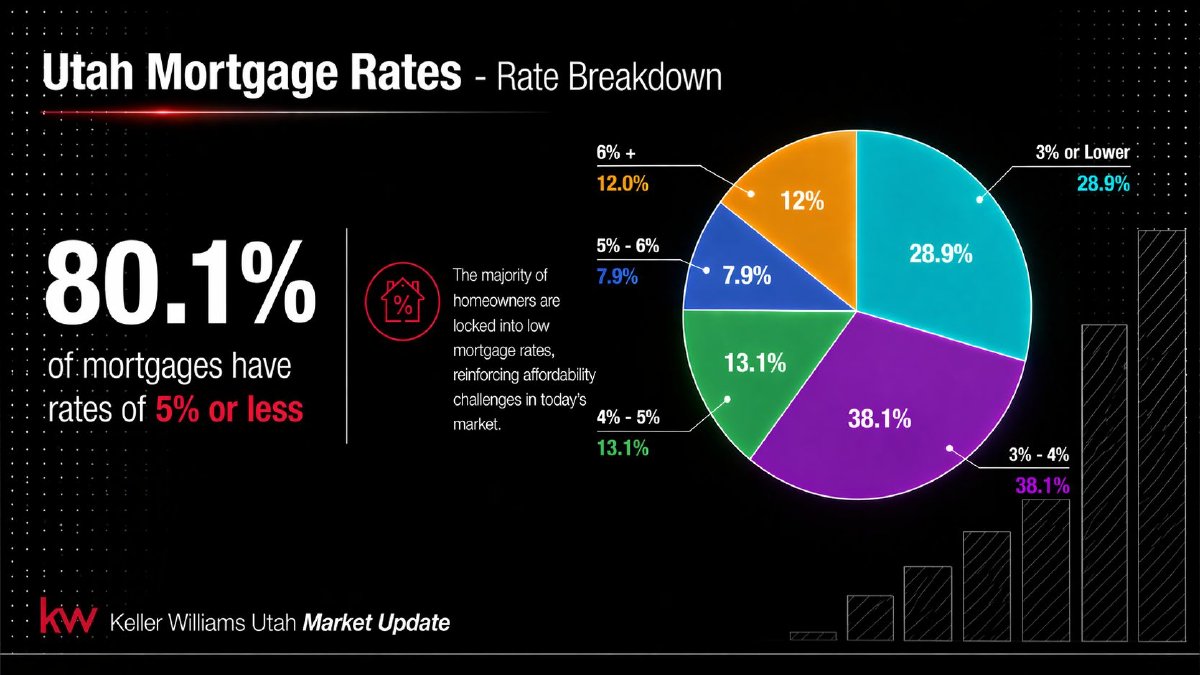
For context, 80.1% of Utah mortgages carry rates of 5% or less, and 28.9% are at 3% or lower. Many owners are holding low rates, which is part of why moving up feels expensive. The deck notes the September rate is still below the 7.72% long-term average for 1972 to 2023, but it's well above the 3.11% annual average in 2020.
How buyers can do well right now
- Know your payment first. Get pre-approved so you know what monthly number works before you fall for a house.
- Look at homes that have sat. A listing past the 65-day average or with a price cut often has a seller ready to talk.
- Ask for seller credits. Use them for closing costs or a rate buydown to bring the payment down.
- Use the inspection. Repair requests and credits are more realistic when fewer buyers are competing.
- Offer based on the data. Comparable sales and time on market should drive your number, not the list price.
PROS AND CONS FOR SELLERS
Source: Keller Williams Utah Market Update, Q3 2026
The pros
- Prices are still near the top. The statewide median was $530,000 in September, up 1.9% from a year earlier.
- Fewer new competitors are coming on. New listings were down 3.9% from September 2025.
- If you're also buying, you get the buyer's leverage too. You may give up some on your sale, but you can try to make it back on your purchase through price, credits or a buydown.
The cons
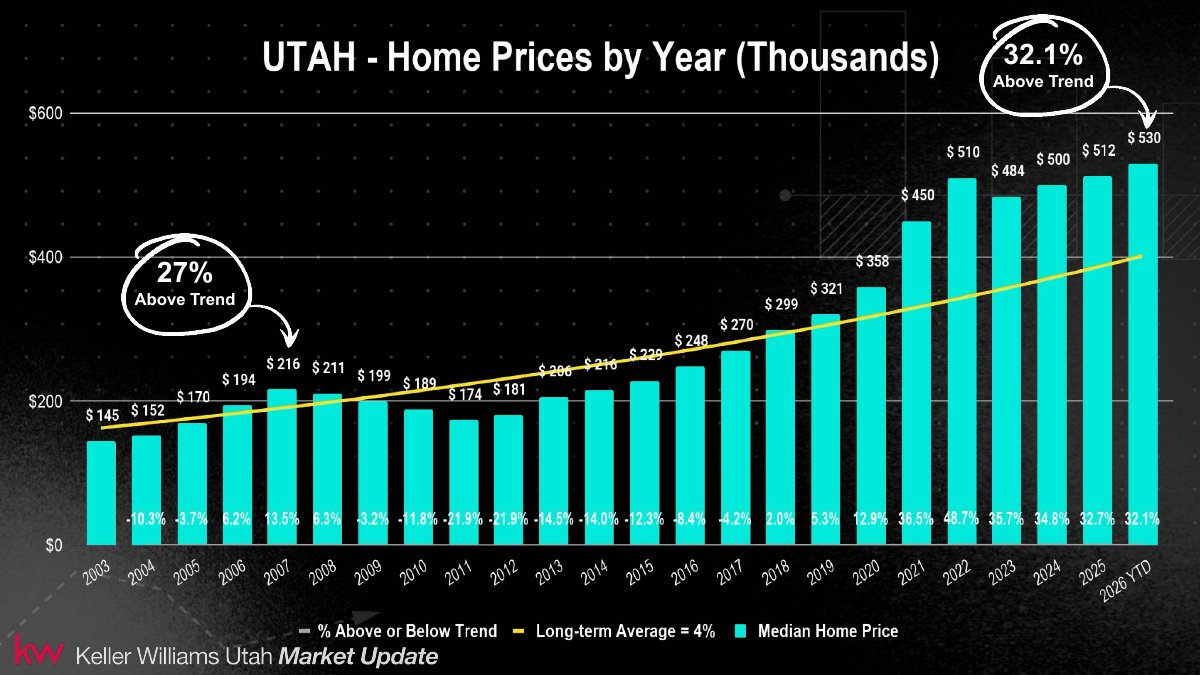
- Prices are stretched. The 2026 median sits 32.1% above its long-term trend line.
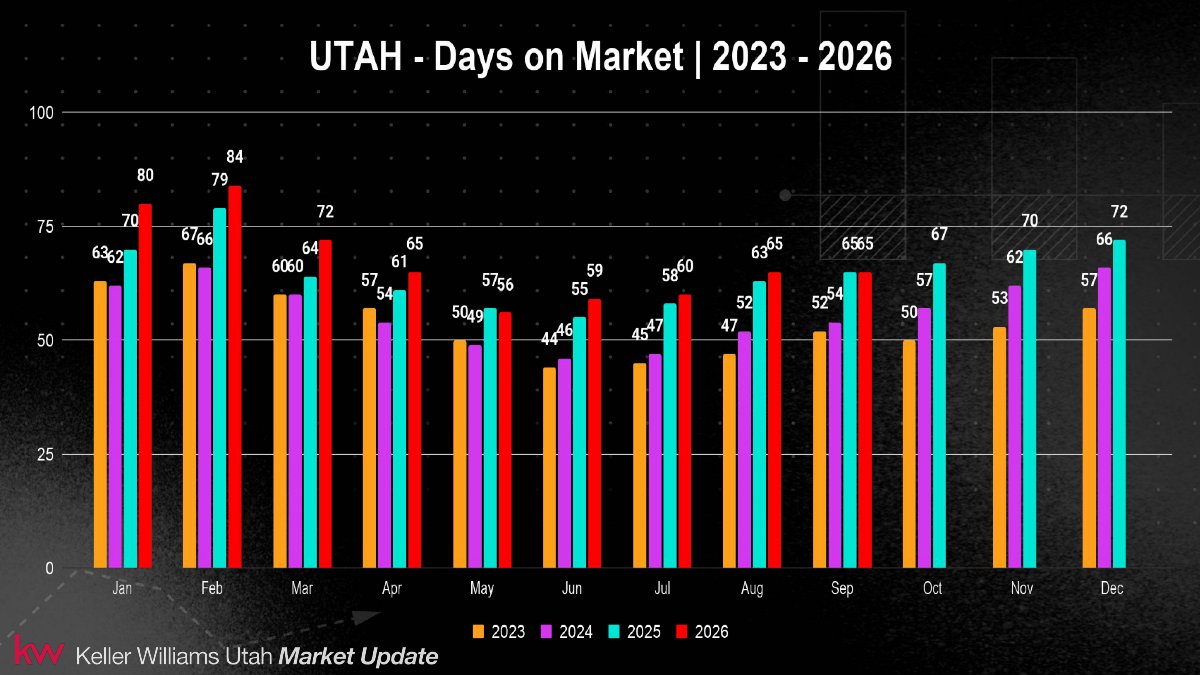
- Homes take longer. Utah homes averaged 65 days on market in September 2026, compared with 52 days in September 2023.
- Price cuts are common. 22.1% of Utah homes had price drops in September, and the typical sale came in below original list.
Source: Keller Williams Utah Market Update, Q3 2026
Why pricing and your agent matter more than ever
In this market, overpriced homes are the ones that sit and end up cutting. The first few weeks bring the most attention, so pricing right from day one matters more than it has in years. That means choosing an agent who:
- Won't sugar-coat your listing. You want honest feedback on condition, competition and price, even when it isn't what you hoped to hear.
- Prices it from real data. Recent sales and time on market, not the number a neighbor got two years ago.
- Markets it hard. Strong photos, wide exposure and a real plan to reach buyers matter when buyers have 17,528 options.
No one can promise a sale price. A smart price and a serious marketing plan give your home its best shot.
WHAT TO DO NEXT
- Buyers: get pre-approved, set your monthly payment limit and make a list of homes that have been listed a while.
- Sellers: get a realistic home value report before you pick a list price.
- Both: if you're selling and buying, plan both sides together so the leverage on your purchase can offset what you give up on the sale.
More reading: Why Aren't Homes Selling Fast? How to Avoid a Stale Listing.
FAQ
Is now a good time to buy a house in Utah?
It can be a good time to negotiate. In September 2026, Utah had 17,528 homes for sale, 4.7 months of supply, and 22.1% of homes had price drops. Homes sold for 96.1% of original list price on average. The payment is still the hard part: the 30-year fixed rate ended September at 6.86%, and the median price was $530,000.
Are Utah home prices dropping?
Not statewide. The Utah median sale price was $530,000 in September 2026, up 1.9% from a year earlier. What is falling on many homes is the asking price: 22.1% of Utah homes had price drops in September.
Is it a buyer's market in Utah?
Buyers have more leverage than they did a year ago. Inventory is up 3.6%, pending sales are down 26.8% and supply sits at 4.7 months. Prices are still up slightly statewide, so the leverage shows up home by home, not as a market-wide discount.
How long do homes take to sell in Utah?
Utah homes averaged 65 days on market in September 2026, the same as September 2025 and up from 52 days in September 2023. Year to date, the average is 66 days, compared with 62 a year earlier.
Should I lower my price if my Utah home isn't selling?
If a home has sat without strong showings or offers, price is usually the first thing to look at. In September 2026, 22.1% of Utah homes had price drops. Pricing right from the start, with honest feedback from your agent, gives a listing its best chance before it goes stale.
Whether you're in Orem, Lehi, Provo or anywhere else in Utah, learn about buying with Red Sign or selling, request a home value report, or connect with an agent. Since 2008, Red Sign Real Estate Team has helped with about 3,500 transactions and earned 1,950+ five-star reviews.

Red Sign Team
Real Estate Team | Red Sign Team | KW Westfield
or another way